
The purpose of this section of the Journal of Massage Science is to inform the practitioners about valuable articles that frequently go unnoticed, as well as to point to those authors and publications who exhibit low educational standards. We do not play politics, and we are not associated with any publishing company or professional association. We are a completely independent voice, and we promise you direct, unbiased reviews based strictly on the science.
If the author of the reviewed article does not agree with our opinion, we will be more than happy to publish his or her response and have a productive discussion over the article’s subject.
At the end of the year, we will recognize and reward the author of the most important publication(s) and point to the authors of the most unscientific publication(s). We hope this will help to raise the bar of published materials in massage journals for the benefit of the entire profession.
Massage

Healing Rhythms. Music and Vibration Augment Massage. Massage 165, Feb, 68-73, 2010
A very good article! It emphasizes the importance and explains the benefits of using music as a background therapeutic tool to enhance the healing impact of massage therapy sessions. This is especially important for those who practice the preventive aspect of massage therapy.
The article explains the impact of various types of music and their combination on the client as well as the practitioner. The correctly chosen music helps to build emotional and psychological links between the client and practitioner. It is a great tool to build up a successful massage practice.
Roll On to Better Session. Massage 165, Feb, 52-57, 2010
In this article, the author describes the method of bodywork she developed using the interaction of a 4-6-inch ball and a massage table while working on the client. She builds her method on a combination of various stretchings, positionings, etc.
What makes this article worth reading is the fact that the author isn’t afraid to actually inform the readers what her treatment session consists of. In many articles, the authors are afraid or don’t have much to say about what exactly they recommend doing, for fear of losing potential student enrollment in the seminars or suffering a decrease in DVD or book sales after the actual content is revealed.
Y. Zake is professional enough to share with the readers what exactly the typical protocol of Yamuna Body Rolling is all about. By reading the article, readers may decide whether they would like to explore and learn this type of therapy or whether this treatment isn’t applicable to their practice. We need more articles like this one instead of promotional pieces.
Research Confirms Intuition – Sometimes. Massage 165, Feb, 68-73, 2010
This is a very good reference source, which reviews modern information about connective tissue and gives reports from various conferences and congresses on the subject of connective tissue and its role in the human body.
Massage & Bodywork
Somatic Research. Massage Therapy. The Invisible Profession? Massage & Bodywork, Jan-Feb, 114-121, 2010
This article introduces a new author of a regular and previously successful column of the M&BM. The author touches many important subjects and helps the massage practitioners to understand and appreciate the importance of scientific research and its impact on the entire profession. Overall, this is an introductory article, and we are waiting for the next article in order to compare the contribution of the new author of the column with the expertise of the previous contributor.
Myofascial Techniques. The Rotator Cuff. Frozen Shoulder. Part 2. Massage & Bodywork, Jan-Feb, 108-113, 2010
A very good and informative article! Great illustrations! It shows that the author knows his subject, and the readers can immediately put the information from the article to work. This is a great example of practical clinical pieces the practitioners need today.
Body Awareness. Bending. Massage & Bodywork, Jan-Feb, 100-101, 2010
Correct body mechanics for massage practitioners is an issue of great importance. Unfortunately, in many cases it is rarely or incorrectly taught in massage schools. As a result, the practitioners develop incorrect body mechanics while working, and it frequently ruins their bodies. The author tries to address this important subject, but in such a complicated manner that in the end the article adds more confusion and has very limited practical value.
Additionally, the illustrations show that the author missed a lot of important issues in describing correct body mechanics, for example, the necessity of contact with the table, the position of the feet, etc.
Without a long explanation of the missed information, we would like to send the readers to the article on Body Mechanics published in Issue #6, 2009: Contents. There, we summarized all the basic information on correct Body Mechanics and presented it in video format.
Essential Skills. Active Isolated Stretching. The Mattes Method. Part 2. Massage & Bodywork, Jan-Feb, 88-93, 2010
A very good article which addresses Isolated Stretching. What we really liked about this article is that the authors recommend its use in combination with other modalities (e.g., massage, local frictions, etc.). This is an important point which many practitioners are missing. After learning one method or technique, they ‘specialize’ in its application, limiting their own technical and ultimately their healing potential.
The final thought: Isolated Stretching is a modified and greatly simplified variant of Postisometric Muscular Relaxation, which is one of the greatest contributions of the American School of Manual Medicine. Since Dr. Mitchell laid the foundation of this method in 1948, it has developed into an entirely new branch of manual medicine called Muscle Energy Techniques. It is surprising to see that the name of the scientist who actually developed this highly effective clinical method isn’t even mentioned.
For those who would like to master the clinical protocol of Muscle Energy Techniques and go beyond the basics of Isolated Stretching, we highly recommend: Mitchell F.L., Mitchell P.K.G. The Muscle Energy Manual. Vol I and Vol II, MET Press, East Lansing.

Functional Anatomy. Diaphragm. Massage & Bodywork, Jan-Feb, 83-84, 2010
We continue what seems like an endless struggle with this author and her misleading articles. What is good about these articles is the fact that we can use them as a starting point for important conversation. Thus, the readers will have the opportunity to obtain correct and useful information from wrongly written pieces.
Information about the anatomy and physiology of the diaphragm is presented correctly. In fact, the diaphragm is a major driving force of respiration, and other respiratory muscles help this major engine to work more efficiently.
However, as usual, the practical part of the article is incorrect. Let’s review how C. Cael recommended that massage practitioners palpate the diaphragm. The video below re-creates the guidelines from the article.
Also let us quote the article:
- Slide fingertips/thumb inferiorly onto the bottom edge of rib cage
- Locate the fibers of the diaphragm by gently sliding under the following the inner surface of the rib cage
- Instruct the client to inhale to assure proper location
The technique of diaphragm palpation advocated in the article doesn’t have anything to do with the diaphragm, especially on the right side, which is shown in the article as an example. What C. Cael actually palpates in this position is the lower edge of the liver, and it is anatomically impossible to reach the diaphragm with the technique recommended in the article. The right lobe of the liver occupies the entire right dome of the diaphragm (see Fig. 1). Pay attention to the lower edge of the liver just under the rib cage.
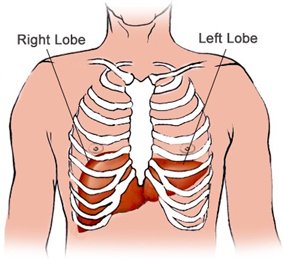
Fig. 2 below shows the anterior abdomen with the edge of the rib cage cut off to expose the liver. The blue line re-creates the lower edge of the rib cage, which was cut off in Fig. 2. Notice that there is no space between the ribs and the anterior surface of the liver (red arrows in Fig. 2). This is why there is no anatomically possible way the author may palpate the diaphragm under the right side of the rib cage. That would be anatomical nonsense.
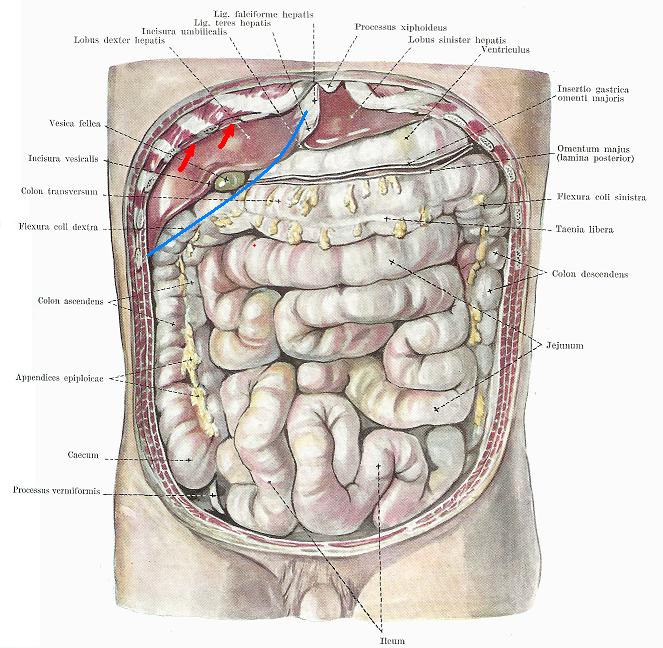
Unfortunately, it is obvious that the author did not bother to even open a basic anatomy textbook and she doesn’t know what she actually touches under the rib cage on the right.
The only area where the diaphragm fibers can be reached directly is under the left side of the rib cage, and there is a special massage technique called Diaphragm Stimulating Technique. However, if the practitioner uses the recommendations from the article, he or she will not be able to reach it on the left side either. The video below shows the correct way of palpating the diaphragm under the left side of the rib cage.
First of all, the client needs to keep their arms alongside the body and flex their knee and hip joints in order to relax the abdominal musculature. Otherwise, the palpation of the diaphragm is useless. Unfortunately, this factor isn’t even mentioned in the article. The client in the picture shown in the article keeps his hands behind his head, holding the lower extremities straight.
Next, the practitioner must place the hand in the completely opposite fashion, i.e., on its dorsal surface. Now ask the client to deeply inhale using abdominal breathing, i.e., breathe from the abdomen instead of the chest. During the exhalation (deflation of the abdomen and descending of the anterior abdominal wall), the practitioner gently slides his or her fingertips arranged in a line in a hook-like position under the rib cage. The actual palpation, or treatment if needed, happens when the client actively inhales (inflation of the abdomen or ascending of the anterior abdominal wall), and at this moment the tips of the 2nd–5th fingers slide along the fibers of the left dome of the diaphragm. As you compare both videos, you can see the critical differences between the correct and incorrect palpation of the diaphragm.
The final thought: correct information is power, and wrong information is a disaster.
Massage Today
Flexor Hallucis Longus Dysfunction. Massage Today, 10(1), January 2010
An excellent article on the topic of ankle and foot pain. Unfortunately, the potential problems of the flexor hallucis longus in the tarsal tunnel and even the tarsal tunnel itself are rarely mentioned. The article describes anatomy, physiology and possible causes of local abnormalities in the area of the tarsal tunnel and the tendon of the flexor hallucis longus muscle. According to the author, the second part of the article will address the treatment options.
Shoulder Pain and Infraspinatus. Massage Today, 10(1), January 2010
This is a very good article on infraspinatus muscle dysfunction. It gives a correct review of anatomy, physiology and possible trigger point locations. The author uses the Travell and Simons textbook as a major source of information, and it validates the information in the article. From our point of view, there are some minor inconsistencies in the treatment part of the article, but a diversity of approaches is what makes massage therapy a great clinical tool.
Sources of Neck Pain. Massage Today, 10(1), February 2010
This article briefly describes several of the most common causes of neck pain and the basic evaluation of the client for each cause. This article is a good quick guide, but it touches on the complicated issue of neck pain superficially. However, the detailed description wasn’t the author’s goal, and she concentrated on two of the most common causes she encountered in her practice: limited range of motion in the shoulder girdle and restrictions in the thorax. Considering that the author showed an advanced level of professional expertise, we think that it would be beneficial for the readers if she concentrated on one cause and gave more detailed clinical information instead of trying to squeeze several causes into one small article. This is the only problem we see with this article.
The Heart of the Matter. Massage Today, 10(1), February 2010
This is an excellent article which provides very unusual information about the exchange or correlation of electromagnetic energy between the heart and the brain. The author encourages us to visit the HeartMath Institute website for further reading, and we encourage the readers to do the same. Thank you for the great referral source!
New Evidence of Breathing and Body/Mind Balance. Massage Today, 10(1), February 2010
There is nothing more to say: Dr. Chaitow, as always, is a brilliant source of information. Even his short publications stand out way above the level of the best massage educators.
Communicating the Importance of Frequent Sessions. Massage Today, 10(1), February 2010
This short article touches a nerve. The practitioner’s ability to deliver a clear, consistent message to the potential client is very rarely addressed or even mentioned in massage therapy schools or massage publications. At the same time, this is an issue of great importance. Any somatic abnormality can be cured by massage therapy only if the practitioner builds up the clinical response. This can happen only with repetitive treatments. There is a very slim chance that one session per week, and no chance at all that one session per month, will be able to eliminate a chronic somatic abnormality.
Thus, the client is faced with the issue of time and money investment. If the practitioner is unable to clearly communicate with the client and explain to him or her the necessity and outcomes of the treatment, the practitioner will fail, and it will be a failure of the entire profession. This is not an overstatement, because the client will never believe in the medical potential of massage therapy anymore and will discourage his friends and relatives. This is why one professional failure has a ripple effect on the entire profession.
This small article tries to address this issue and the author does it effectively. Of course, this issue is much more complicated, but the author does a very good job of giving outlines for correct behavior and the ability to build up a professional conversation with the client before treatment begins.
Category: Good Apples, Bad Apples
Tags: JMS 2010 Issue #2
