
69-year-old male
Very active. Likes to hike, bicycle, work out, play golf, etc.
His symptoms were pain and irritation from the low back to the feet with the feet being the most problematic area. The patient was seeing a podiatrist and was prescribed various shoe supports, socks, creams, etc., with no improvement in the symptoms. The neurologist ordered an MRI, which concluded that the patient had Spondylolisthesis as a result of Pars Defect. The neurologist also determined that his foot problem was muscle wasting in the feet as a result of his back problems.
I was familiar with Spondylolisthesis, and I knew that the MEDICAL MASSAGE PROTOCOL could be used on those patients, but very carefully. However, I wasn’t aware of Pars Defect. I went to the internet and what I found completely changed my treatment plan. Since Pars Defect is a bony defect of the vertebral arch, it lets the affected vertebra slip forward, creating the condition of Spondylolisthesis.
Since Pars Defect was present, my treatment protocol needed to exclude the usual parts I do with patients who suffer from lower back pain: passive hip flexion, upper body rotations, etc.
I evaluated his situation and found muscular trigger points in the lumbar erectors, QLs and piriformis muscles. I removed these trigger points, and there was immediate significant relief for all symptoms. I worked on him a total of three times. The third time the patient came to see me, he presented no muscular abnormalities yet still had some foot irritation. I gave him pool exercises to do. He did them for 30 days in a row. His low back continued to improve, but his feet were still irritated. I decided to stretch the sciatic, common peroneal and tibial nerves as I had learned during SOMI Medical Massage seminars. The results were nothing short of amazing. The patient called me several hours later to report that the irritation in the feet was almost totally resolved. However, they did come back in a day with less intensity. I continue to work with him.
Curt Lezanic, LMT, CMMP
LESSONS
- It is always good to have contact with the patient’s physician or do some independent research as soon as something isn’t familiar.
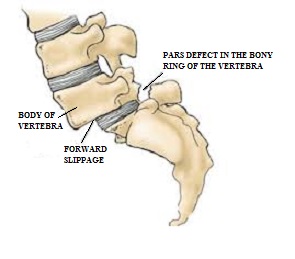
- Pars Defect, which is illustrated below in Fig. 1, is a defect in the vertebral arch which forms as a result of an acute fracture or a stress fracture at a younger age, especially among young athletes. As a result of this defect, the upper vertebra slips forward and creates instability within the vertebral segment with subsequent compression of the spinal nerve and severe spinal stenosis.

Fig. 1. Pars Defect - If the patient has Pars Defect, especially bilateral, the therapist should avoid any lower back stretching, especially flexion and middle back muscle stretches using the rotation. All myofascial release, Rolfing, and kinesiology moves you may have learned are out of the question for these patients.
ABOUT THE AUTHOR

Curt Lezanic, LMT, CMMP
Curt Lezanic received both a Bachelor of Science and a Master of Science degree in education from Kearney State College, now known as the University of Nebraska at Kearney. His teaching experience includes junior high and senior high teaching in public education and faculty positions in higher education. Administratively, he has worked as a department head, dean and campus director primarily at the community college level.
In the early 1990s, Curt returned to the classroom as a student to pursue massage therapy. He worked for several years at a local resort/spa as a contract massage therapist and developed a local clientele. In 2009, Curt was approached by Dr. Scott Campbell. Dr. Campbell asked Curt to work with several of his patients who were experiencing various muscular/skeletal issues. Over the next several months, what had begun as a part-time, on-call relationship with Dr. Campbell grew into what was becoming a full-time commitment. In 2010, Curt retired from the college where he had worked for twenty-two years and established his massage practice at the office of Dr. Scott Campbell in San Antonio, Texas.
Category: Blog , News
Tags: JMS 2015 Issue #4
