
This article was contributed by Karen Mooney, LMT, PhD, CMMP. She is our former student and is an exceptionally talented therapist, educator and now massage scientist. We don’t have many PhDs in our profession who earned their degree specifically in the massage therapy field. However, this is not all. Karen’s PhD is the first degree in the USA awarded to a therapist in the Medical Massage field, and this is the most exciting news for all of us at SOMI and, we hope, for all massage therapists.
Here is the opinion Dr. D. Moss, Chair of the Graduate School of Mind-Body Medicine at Saybrook University, expressed about Karen’s PhD dissertation:
“This is one of the best written and best edited dissertations I have ever received for review. Each chapter is well organized and clear. I am just completely impressed and proud of the work you have done. You know me. I usually send back pages of red marks and comments. No student has ever received so little markup the first time a final copy was submitted. This is an excellent study, and must get published.”
Dr. D. Moss
The article you will read below summarizes the results of a study Karen conducted to examine the effect of soft tissue rehabilitation in patients with Fibromyalgia. There is another unique aspect of her work. Instead of testing a single modality or approach, Karen put into practice the main point of our vision, which she also shares – successful somatic rehabilitation as a result of the integration of different modalities. It is a dead end in our profession if therapists let themselves be pulled into a world where massage therapy is fragmented, and Karen’s PhD is a great illustration of how it should be.
INTRODUCTION
The purpose of this study is to evaluate an integrative mind-body protocol that has been specifically developed for mitigation of symptoms in Fibromyalgia (FM) patients.
According to the National Fibromyalgia Association, this chronic pain disorder:
“affects an estimated 10 million people in the U.S. and an estimated 3-6% of the world population. It is most prevalent in women – 75-90% of the people affected.”
There are no lab tests or imaging techniques that provide conclusive evidence of FM presence in the patient (Fürst, 2007), but rather, assessment depends on symptom severity (Clauw, 2009). The accumulation of research has led to inconsistencies, confusion, and ineffectual treatment plans (Häuser et al., 2010). FM has been notoriously unresponsive to allopathic medical treatments (Adsett, 2007; Simms, 1998).
The etiology remains conjectural, and the central mechanisms hypothesis (Vierck, 2006) is the dominant concept, which concentrates on central disinhibition, central sensitization, and the dysfunctional response of the hypothalamus–pituitary–adrenal axis (HPA):
“Pain signaling is a complex interaction between ascending and descending pathways between the spinal cord and brain.” (Krypel, 2009, p. 7)
These studies shed light on the whole-body response to pain for the FM patient, but make no claim to define the etiology of pathophysiological events associated with FM.
Some researchers look beyond the central nervous system’s changes and imbalances in the modulating pathways (Yunus et al., 1989; Staud, 2004, 2006; Turchaninov, 2006; Vierck, 2006). These authors acknowledge the bidirectional relationship (Fig. 1) between hypersensitive nociceptive input and heightened central pain processing but do not believe it originates in the CNS. The focus of this group turned to a peripheral root source for the hyperalgesia. Figure 1 summarizes the bidirectional distribution of clinical pain and hypersensitivity of FM patients.
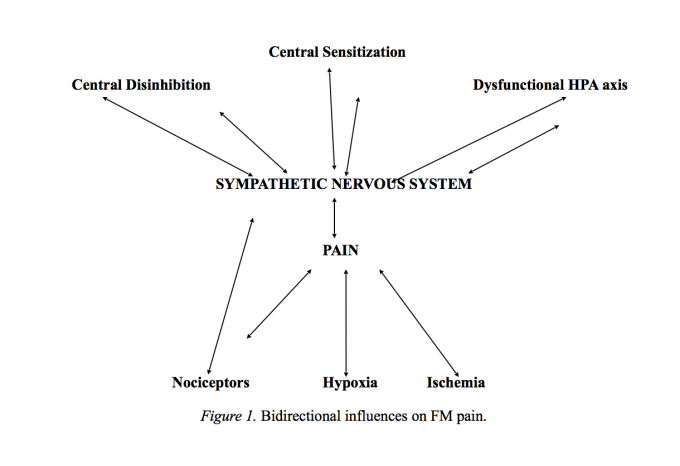
The role of peripheral mechanisms in the changes of the CNS is subject to much conjecture. Some progress in understanding the relationship has been made with the factors identified by Vierck (2006), who acknowledged that until a source is recognized in the CNS, peripheral mechanisms must be considered.
In the systematic review of this study (Mooney, 2015), muscle pathology has been shown to have a clear origin and progression (Popelansky & Ivanichev, 1984; Yunus et al., 1989; Sprott et al., 2004) that explains many of the events leading to the hyperalgesia in the soft tissues and, ultimately, the changes in the central nervous system, viscera, emotions, and behaviors associated with FM. However, the initial trigger of the onset of muscle pathology associated with FM occurs following physical or emotional trauma or stress.
The development and progression of muscle abnormalities offers an explanation for the peripheral mechanisms observed in patients with FM (Mooney, 2015). These events appear to be provoked by a physical and/or emotional impact (Goldenberg, 1999; Ogden et al., 2006; Scaer, 2007; Staud, 2007), chronic overuse of a muscle group (Popelansky & Ivanichev, 1984), or a history of accumulated distress. These circumstances set the stage for an unresolved stress response in the body or somatization and muscle pathology resulting in ischemia and hypoxia (Levine, 1996; Ogden et al., 2006; Popelansky & Ivanichev, 1984; Scaer, 2007).
STANDARD TREATMENT STRATEGIES
Since the theory of central mechanisms of FM currently prevails, the array of medications used to address symptoms of FM includes antidepressants, opioids, nonsteroidal anti-inflammatory (NSAIDs) drugs, muscle relaxants, anticonvulsants, sedatives, analgesics, and hypnotic agents (Han et al., 2011).
The overall failure of pharmacological intervention and its erratic results have caused some authors to suggest other forms of therapy with or without the drug treatments (Fürst, 2007; Jahan et al., 2012; Littlejohn & Walker, 2002; Staud, 2010).
STUDY DESIGN
The two major components of the protocol were combined in this research – Medical Massage and Gentle Movement Therapy. They were chosen to address the symptoms, provide a proactive treatment plan, and create a supportive, motivating environment while addressing:
- The somatic expression of trauma
- The hypertonicity in muscles and formation of tender points
- Low-grade ischemia
- Insufficient drainage
- The limiting influence of adaptive movement patterns
- The cognitive and pathological influences on the mind and body of the patient with FM
- Formation of pain perception by the brain
Six individuals were asked to complete interviews, questionnaires, personal journals, and to assist with progress notes. The participants previously diagnosed with FM by an attending physician using the American College of Rheumatology preliminary diagnostic criteria for FM (Wolfe et al., 2010) were randomly selected from a large group of volunteers providing the critical cases.
A copy of the diagnostic criteria was given to each volunteer, and a suggestion was made to all volunteers to consult with their attending physician. Each person came into the study at a different stage of FM and each was expected to respond differently to the study’s intervention program. Volunteers presently taking an opioid medication or ketamine in any form were not included. Taking other medications or supplements was acceptable. Participants were asked not to add any new medications or treatments during the study. Also, patients under active chiropractic care were excluded.
The design of this study utilized a mixed method approach including a multiple case study (qualitative) and pre- and post-intervention measurements (or repeated measures) for quantitative data. The study relied on the experience of the individual case to answer the questions (intrinsic), but the study also served as an instrument to further understanding of FM (Stake, 1995). Table 1 is a summary of the data collection instruments, the time each was used, and the reasons for selection.
| Intake Interview | Before treatment protocol or the first week preceding the study | Qualitative
Medical history Symptoms Medications Interventions Lifestyle Onset of problem Baseline |
| Personal Journaling | First week and continuing throughout the study | Qualitative
Subjective self-report of pertinent daily behaviors, symptoms, changes, needs |
| Progress Notes | Sequential with intervention | Qualitative
Therapist & participant report |
| Revised Fibromyalgia Impact Questionnaire (FIQR) | First week preceding study;
Within 5 days following study |
Quantitative
Current Evaluation: physical functioning socio-cultural impact, ability to perform mental tasks |
| The Brief Pain Inventory
(BPI) |
First week preceding study;
Within 5 days following study |
Quantitative
Self-report of the intensity and the reactive dimension of pain |
| Patient Global Impression of Change (PGIC) | Within 5 days following study | Quantitative
Overall improvement in pain and symptoms |
| Exit interview | Within 5 days following study | Qualitative/Quantitative
retake assessments subjective impressions |
COMPONENTS OF THE PROTOCOL
The first phase of the intervention protocol consists of twelve 40- to 60-minute treatments of Medical Massage. To elicit clinical changes for the participants with FM, the protocol intervention uses techniques of the Medical Massage modality to address the peripheral mechanisms with the expectation that normalization of the function of soft tissues will correspondingly normalize the function of the CNS affected by chronic activation of nociceptors.
The role of the MEDICAL MASSAGE PROTOCOL in this effort is essential to:
- release the somatic manifestations
- reset the balance between the sympathetic and parasympathetic divisions of the autonomic nervous system
- treat hypertonically changed muscles eliminating tender points
- decrease intensity of pain perception
- allow the participant to experience his or her own body in a positive way
- restore normal blood flow and drainage through the affected soft tissue
- validate the participant’s perception of the state of the body while creating a compassionate, safe, and nurturing environment
- address the chronic, persistent psychological aspects of FM
First phase: Medical Massage
Each session began with the participant lying prone in anatomical position, using a face cradle and a foot bolster of comfortable size. Attention to comfort, temperature, position, sounds, present pain levels, and areas of hyperalgesia was paramount. All factors for each individual and each session were recorded in treatment notes.
A discussion of pressure and discomfort alerted the participant to be vigilant and control these factors throughout the session. Feedback is imperative to enable the practitioner to meet the goals of the treatment but also for the patient to express and control personal needs.
Described here are the initial 2 sessions of therapeutic massage in the inhibitory regime (Turchaninov, 2006) applied to the upper torso only. To avoid potential autonomic reactions like nausea, headaches and flu-like symptoms following massage reported by many FM patients, this method was selected to consider the years of accumulated metabolic ‘waste’ resulting from the low-grade ischemia and pathologically changed drainage in the affected soft tissues.
These initial sessions establish rapport, trust in the process, patient control, and enable the therapist to assess the tolerance and needs of each person. In a sense, these initial sessions formed the skeleton of the therapy with further addition of specific Medical Massage techniques into each treatment session while addressing each of the tender points associated with the personal pattern of FM distribution in each patient.
The practitioner should be aware that the goals listed previously apply to each session. The pressure of all strokes must be comfortable for the patient and below the personal pain threshold. With every session this threshold was reassessed for each contact area. Please refer to Therapeutic Massage: A Scientific Approach (Turchaninov, 2000) for the definition and proper technique of each stroke used during the therapy.
Step 1: Addressing the whole back from sacrum to cervical and across shoulders, apply long, gentle, bimanual effleurage strokes. This allows the practitioner to activate the parasympathetic response, initiate a state of relaxation, and assess the contact areas for pain thresholds. Using full hand effleurage strokes, cover the entire back from sacrum to cervical for several minutes. The strokes should be consistent, smooth, and non-aggressive. It is important to next address the paravertebral muscles on each side with the Big Fold stroke. Begin on the most affected side with the Big Fold technique first, then move to the least affected side and apply the same.
Step 2: Remaining on the least affected side and working across the body, apply the stronger effleurage strokes to the neck and shoulder from medial to lateral in the direction of drainage. Continuing in the inhibitory regime, add a full hand repetitive friction moving down the neck, across and to the point of the shoulder. Adjust pressure to what is comfortable, maintain contact, and follow with effleurage. The practitioner then physically moves to the most affected side to continue addressing that shoulder, scapula and upper thoracic area with general effleurage in the direction of drainage and non-specific friction strokes. While maintaining contact, return to the other side and work across the body again with raking effleurage and friction from thoracic to lumbar between ribs.
Step 3: Effleurage and friction through the lumbar and sacral area, addressing the soft tissue insertions. Move up the back again with the Big Fold. Move again to the same side and effleurage the entire side of the back. Big Fold the paravertebrals on the opposite side, then repeat steps 1 through 3 on that side of the back.
Step 4: Finish the posterior by addressing the whole back again from sacrum to cervical with various effleurage strokes. The patient often comments that this feels as if the parts are reconnected to the whole.
Step 5: Turn the patient to the supine position. Apply effleurage and friction to arms, shoulders, neck, and complete gentle facial massage in the direction of the drainage to the anterior neck.
Second phase: Slow Movements
The second component in the protocol is a 6-session program of structured movements. The movement class is a group activity, meeting for 1 hour a week for six sessions. The movement group meets simultaneously with the Medical Massage interventions. In a clinical setting the movement class would include other mind/body interventions such as guided imagery and visualization.
The formation of chronic hypertonic muscle pathology eventually results in new muscle patterns which limit range of motion and normal function (Hanna, 1988). Acknowledging the influence of somatization of stress or trauma and musculoskeletal dysfunctions in cases of FM supports the clinical relevance of the movement portion of the protocol.
Exercise and aerobics have been studied and used with FM patients, but the focus has not been to restructure the cortical maps, release the trauma, or to alter the pathological progression (Häuser et al., 2010). To restructure the brain map into a more productive movement pattern, it is necessary to expand and refine attention through slow, exact movements while focusing on the sensation of the movement (Feldenkrais, 1977; Daly & Ruff, 2007).
The slow repetitive movement rebalances agonist/antagonist muscles, decreases the efforts of muscle synergists, and reduces muscle hypertonicity. For example, as the patient slowly and methodically moves the legs in a precise pattern, the threshold of the muscle spindle receptors is reset but in a careful, nurturing manner. The patient is then able to adjust the movement to the new threshold and increase the range of motion without creating any muscle tension. As the range of motion increases, with cautious adjustments, the muscle tension is reduced and so is the associated, devastating ischemia (Feldenkrais, 1977; Turchaninov, 2006).
Movement goals include:
- awareness and release of restrictive patterns
- awareness and release of pain patterns
- providing a proactive response to stress
- reconnecting the motor cortex and muscle spindle receptors within the normal, physiological range
- reorganizing the cortical maps (Hanna, 1990-1991; Mahncke et al., 2006)
- awareness of personal somatic responses to stress/trauma, and reducing muscle tension
RESULTS
Please read the complete statistical analysis results. The information presented below is a shortened version of the original study results.
Quantitative Data and Analysis
1. Revised Fibromyalgia Impact Questionnaire (FIQR)
According to the results of the Revised Fibromyalgia Impact Questionnaire, the participants in this study showed a statistically significant difference between the scores at the base measurement and the end scores post-intervention with high practical significance of this change.
The statistical results suggest all participants experienced relief from the FM symptoms that limited their normal daily activity and each participant’s ability to function in everyday tasks was enhanced.
The total FIQR demonstrates a significant difference between the pre-intervention total (T) score (M = 56.50, SD=14.00) and the post-intervention total score (M = 39.66, SD = 14.14); t (5) = 8.68, p < .001. The Cohen’s d effect size value (d = 1.20) suggested a high practical significance.
2. Brief Pain Inventory (BPI)
The BPI is used to measure the severity and interference of pain in everyday life. For the participants in this study there was a statistically significant difference between the scores at the base measurement (M = 6.00, SD = 1.90) and at the end measurement (M = 4.17, SD = 1.60); t (5) = 2.60, p = .048. Further, the Cohen’s effect size value (d = 0.96) suggested a high practical significance.
3. Patients’ Global Impression of Change (PGIC)
The PGIC was administered post-intervention, providing the participants an opportunity to report any clinical changes. Hurst and Bolton (2004) outlined and noted on the PGIC questionnaire the interpretation of this subjective outcome measurement:
- A significant, favorable change is a score of 5–7
- No significant change is a 1–4 response
Also
- A 2-point change indicates significant improvement from their last reported score.
Five participants in our study indicated a score of 6, while one indicated a score of 5. Also, four of the participants indicated a 2-point change since the beginning of the intervention.
Qualitative Data and Analysis
For the qualitative inquiry in this mixed-method research, a case study approach provided an in-depth understanding of the experience of each participant. Common themes that related to the research question, “How efficacious is a specific theory-based approach, including Medical Massage and movement therapy, in reducing the symptoms of patients with FM?” added another dimension to the quantitative results. The focus on key issues or themes began within each case followed by a thematic cross-case analysis.
Each participant reported some changes in at least one area of her life. For most it was a reduction in pain, and for some, it was a renewal of their sense of self. It seemed to them that any positive change gave them more hope and power, therefore increasing the quality of life.
CONCLUSION
The results of this theory-based protocol for the treatment of FM, including Medical Massage and Gentle Movement Therapy, showed a statistically significant effect on the mitigation of symptoms for the participants (N = 6) with FM. It is important to reiterate that the protocol evaluated in this study is based on the theory that muscle pathology is a key peripheral mechanism, and that trauma plays a critical role.
Although the theory of FM’s central origin currently prevails and there is an abundance of evidence for central processes being affected in FM, the importance of certain peripheral mechanisms has been recognized. Vierck (2006) credits “abnormal peripheral input(s) for development and maintenance of this condition (FM)” (p. 242), which necessitates a better understanding of the mechanisms to develop and document adequate therapies.
The statistical results provided preliminary evidence that the protocol may be effectual in improving functional deficits and symptoms of FM. The general improvements noted in the statistical findings of the study included a decrease in pain and muscle tension; less depression and anxiety; and an increased ability to function, set goals and limits.
The qualitative summary of each theme reflected that although the time allowed for this study was limited, participants experienced a substantial reduction in pain and therefore an increase in the QoL. One participant made the comment that “we cannot heal without addressing both the mind and the body parts of this illness” (JK). We might clinically transfer this information to other treatment plans for patients with FM.
This study also may be a springboard to further investigation of the progression of muscle pathology discussed here as the “abnormal peripheral input(s) for development and maintenance of this condition (FM)” (Vierck, 2006, p. 242).
REFERENCES
- Adsett A. Book review: somatization disorders: treating somatization: a cognitive-behavioral approach. Can J Psychiatry. 2007;52(10):690. doi:10.1177/070674370705201012
- Bennett RM, Friend R, Jones KD, Ward R, Han BK, Ross RL. The Revised Fibromyalgia Impact Questionnaire (FIQR): validation and psychometric properties. Arthritis Res Ther. 2009;11(4):R120. doi:10.1186/ar2783
- Boomershine CS. A comprehensive evaluation of standardized assessment tools in the diagnosis of fibromyalgia and in the assessment of fibromyalgia severity. Pain Res Treat. 2012;2012:653714. doi:10.1155/2012/653714
- Buskila D, Cohen H. Comorbidity of fibromyalgia and psychiatric disorders. Curr Pain Headache Rep. 2007;11(5):333-338. doi:10.1007/s11916-007-0214-4
- Choy E, Perrot S, Leon T, et al. A patient survey of the impact of fibromyalgia and the journey to diagnosis. BMC Health Serv Res. 2010;10:102. doi:10.1186/1472-6963-10-102
- Clauw DJ. Fibromyalgia: an overview. Am J Med. 2009;122(12 suppl):S3-S13. doi:10.1016/j.amjmed.2009.09.006
- Daly JJ, Ruff RL. Construction of efficacious gait and upper limb functional interventions based on brain plasticity evidence and model-based measures for stroke patients. ScientificWorldJournal. 2007;7:2031-2045. doi:10.1100/tsw.2007.299
- Feldenkrais M. Awareness Through Movement. Harper & Row; 1977.
- Fürst G. Fibromyalgia—a challenge for interdisciplinary management. Wien Med Wochenschr. 2007;157(1-2):27-33. doi:10.1007/s10354-006-0368-4
- Goldenberg D. Treatment of fibromyalgia syndrome. Rheum Dis Clin North Am. 1989;15(1):61-71. doi:10.1016/S0889-857X(21)00033-8
- Goldenberg DL. Fibromyalgia syndrome a decade later: what we have learned. Arch Intern Med. 1999;159(8):777-785. doi:10.1001/archinte.159.8.777
- Han C, Lee SJ, Lee SY, et al. Available therapies and current management of fibromyalgia: focusing on pharmacological agents. Drugs Today (Barc). 2011;47(7):539-557. doi:10.1358/dot.2011.47.7.1603503
- Hanna T. Somatics: Reawakening the Mind’s Control of Movement, Flexibility, and Health. Addison-Wesley; 1988.
- Hanna T. Clinical somatic education: a new discipline in the field of health care. Somatics. 1990-1991;8(1):4-10.
- Harris RE, Clauw DJ. Newer treatments for fibromyalgia syndrome. Ther Clin Risk Manag. 2008;4(6):1331-1342. doi:10.2147/TCRM.S3396
- Häuser W, Thieme K, Turk DC. Guidelines on the management of fibromyalgia syndrome: a systematic review. Eur J Pain. 2010;14(1):5-10. doi:10.1016/j.ejpain.2009.01.006
- Hurst H, Bolton J. Assessing the clinical significance of change scores recorded on subjective outcome measures. J Manipulative Physiol Ther. 2004;27(1):26-35. doi:10.1016/j.jmpt.2003.11.003
- Jahan F, Nanji K, Qidwai W, Qasim R. Fibromyalgia syndrome: an overview of pathophysiology, diagnosis and management. Oman Med J. 2012;27(3):192-195. doi:10.5001/omj.2012.44
- Krypel LL. Fibromyalgia: a review of its pathophysiology and drug treatment. J Pharm Pract. 2009;22(1):6-16. doi:10.1177/0897190008322151
- Levine P. Somatic Experiencing research and articles. Somatic Experiencing International. Accessed August 16, 2026. https://traumahealing.org/se-research-and-articles/
- Leza JC. Fibromyalgia: a challenge for neuroscience. Rev Neurol. 2003;36(12):1165-1175. doi:10.33588/rn.3612.2003154
- Littlejohn GO, Walker J. A realistic approach to managing patients with fibromyalgia. Curr Rheumatol Rep. 2002;4(4):286-292. doi:10.1007/s11926-002-0036-7
- Lucas HJ, Brauch CM, Settas L, Theoharides TC. Fibromyalgia: new concepts of pathogenesis and treatment. Int J Immunopathol Pharmacol. 2006;19(1):5-10. doi:10.1177/205873920601900102
- Mahncke HW, Bronstone A, Merzenich MM. Brain plasticity and functional losses in the aged: scientific bases for a novel intervention. Prog Brain Res. 2006;157:81-109. doi:10.1016/S0079-6123(06)57006-2
- Mooney K. Exploring the Role of Peripheral Mechanisms: An Evaluation of a Theory-Based Approach to Reducing Symptoms of Fibromyalgia. Doctoral dissertation. Saybrook University; 2015. ProQuest publication 3711757.
- National Fibromyalgia Association. Fibromyalgia prevalence. Accessed August 16, 2026. https://www.fmaware.org/fibromyalgia-prevalence/
- Ogden P, Minton K, Pain C. Trauma and the Body: A Sensorimotor Approach to Psychotherapy. WW Norton; 2006.
- Popelansky YY, Ivanichev GA. Manual Therapy of Local Hypertonuses: PIR Method. Kazan University; 1984.
- Rasmussen LB, Mikkelsen K, Haugen M, Pripp AH, Førre OT. Treatment of fibromyalgia at the Maharishi Ayurveda Health Centre in Norway: a six-month follow-up study. Clin Exp Rheumatol. 2009;27(5 suppl 56):S46-S50.
- Rogers CR. Toward a modern approach to values: the valuing process in the mature person. In: Kirschenbaum H, Henderson VL, eds. The Carl Rogers Reader. Houghton Mifflin; 1989:168-185.
- Scaer RC. The Body Bears the Burden: Trauma, Dissociation, and Disease. 2nd ed. Haworth Medical Press; 2007.
- Simms RW. Fibromyalgia is not a muscle disorder. Am J Med Sci. 1998;315(6):346-350. doi:10.1097/00000441-199806000-00002
- Sprott H, Salemi S, Gay R, et al. Increased DNA fragmentation and ultrastructural changes in fibromyalgic muscle fibres. Ann Rheum Dis. 2004;63(3):245-251. doi:10.1136/ard.2002.004762
- Stake RE. The Art of Case Study Research. Sage; 1995.
- Staud R. Fibromyalgia pain: do we know the source? Curr Opin Rheumatol. 2004;16(2):157-163. doi:10.1097/00002281-200403000-00016
- Staud R. Are tender point injections beneficial? The role of tonic nociception in fibromyalgia. Curr Pharm Des. 2006;12(1):23-27. doi:10.2174/138161206775193235
- Staud R. Treatment of fibromyalgia and its symptoms. Expert Opin Pharmacother. 2007;8(11):1629-1642. doi:10.1517/14656566.8.11.1629
- Staud R. Pharmacological treatment of fibromyalgia syndrome: new developments. Drugs. 2010;70(1):1-14. doi:10.2165/11530950-000000000-00000
- Turchaninov R. Therapeutic Massage: A Scientific Approach. Aesculapius Books; 2000.
- Turchaninov R. Medical Massage. 2nd ed. Aesculapius Books; 2006.
- Tylee A, Gandhi P. The importance of somatic symptoms in depression in primary care. Prim Care Companion J Clin Psychiatry. 2005;7(4):167-176. doi:10.4088/PCC.v07n0405
- Van Houdenhove B, Egle UT. Fibromyalgia: a stress disorder? Piecing the biopsychosocial puzzle together. Psychother Psychosom. 2004;73(5):267-275. doi:10.1159/000078843
- Vierck CJ Jr. Mechanisms underlying development of spatially distributed chronic pain (fibromyalgia). Pain. 2006;124(3):242-263. doi:10.1016/j.pain.2006.06.001
- Williams DA, Arnold LM. Measures of fibromyalgia: Fibromyalgia Impact Questionnaire, Brief Pain Inventory, Multidimensional Fatigue Inventory, Medical Outcomes Study Sleep Scale, and Multiple Ability Self-Report Questionnaire. Arthritis Care Res (Hoboken). 2011;63(suppl 11):S86-S97. doi:10.1002/acr.20531
- Wolfe F, Clauw DJ, Fitzcharles MA, et al. The American College of Rheumatology preliminary diagnostic criteria for fibromyalgia and measurement of symptom severity. Arthritis Care Res (Hoboken). 2010;62(5):600-610. doi:10.1002/acr.20140
- Yunus MB, Kalyan-Raman UP, Masi AT, Aldag JC. Electron microscopic studies of muscle biopsy in primary fibromyalgia syndrome: a controlled and blinded study. J Rheumatol. 1989;16(1):97-101.
Category: Medical Massage
Tags: JMS 2016 Issue #1
