
Recently, a 35-year-old male presented to our clinic with symptoms of bilateral neck and right-sided mid back pain. His entire hand was numb and tingling. He said that this pain started approximately 6 years after a motorcycle accident. He was ejected from a motorcycle at a high speed when a car ran in front of him. He was thrown through the driver’s side window and landed on the driver’s lap. The right side of his head, neck and shoulder sustained most of the impact. He was knocked unconscious, was in critical condition and was airlifted to the hospital.
After the trauma, he received 3 months of physical therapy for his neck and right shoulder, which provided minimal relief. He led a very active life prior to the accident, was involved in baseball and golf, and went to the gym daily. He said the constant pain was greatly affecting his daily activities and greatly affecting the quality of his life.
Besides physical therapy, he used chiropractic care, but the relief was temporary and the symptoms would return. He had been supplementing his diet with white willow bark and was using topical analgesics: Cryoderm Heat at night and Cryoderm Cold during the day.
The patient rated his right neck and right mid back pain at a 5-6/10 and his right upper extremity and hand pain at a 6-7/10 on the Mankoski Scale. He described the pain in the neck as constant and aching. He felt constant radiating and shooting pain to the right upper extremity with tingling and numbness into the entire right hand. He noticed that the intensity of the symptoms worsened when the weather became cold. He also mentioned that his symptoms were aggravated by shoulder adduction, as when he did chest exercises and when he slept on his right shoulder.
My initial impression was that he had Anterior Scalene Syndrome and possibly right-side Rotator Cuff Syndrome. My next step was soft tissue evaluation.
EVALUATION
Examination of Movements
- Cervical ROM: bilateral restriction of cervical rotation and lateral flexion. Worse to the right.
- Shoulder ROM: limited right shoulder adduction and flexion.
Palpatory Examination
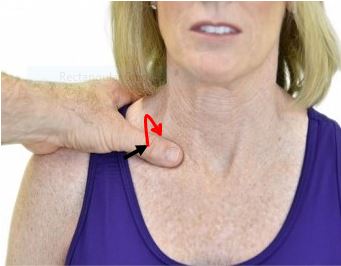
- Wartenberg’s Test was positive, indicating tension in his right-side Anterior Scalene Muscle (ASM) and entrapment of the brachial plexus there. I suggest that all therapists use this simple test on each patient with any abnormality in the upper extremity. Wartenberg’s Test allows you to rule out irritation of the nerves of the brachial plexus by ASM, which is a very frequent cause of abnormalities in the function of the upper extremity.

Wartenberg’s Test Black arrow – application of horizontal pressure strong enough to feel pulsation of the subclavian artery
Red arrow – thumb rolls behind the clavicle - Adson’s Test was also positive on the right, and it confirmed the presence of circulatory abnormalities in the upper extremity due to severe spasm in the right ASM. Thus, the positive Adson Test indicated that the clinical picture had already passed the stage of Anterior Scalene Muscle Syndrome and now the patient suffered from Thoracic Outlet Syndrome.
- Trigger Point Test – Positive Jump Sign on the right Rhomboid, right Pectoralis Minor, Brachialis, Extensor Carpi Radialis Longus.
- Sensory Test – Confirmed the presence of Hypoesthesia (i.e., decrease of sensation during the skin stimulation on the affected side compared to the unaffected side). The Sensory Test was positive on the hand within the distribution of the ulnar, median and radial nerves on the right, and it meant that all nerves which supply the hand were irritated.
- Connective Tissue Zones – Testing indicated the presence of tension in the CTZs in the skin (positive Kibler’s Technique), superficial fascia (positive Dicke’s Technique) and deep fascia (positive Opposite Shift Technique) on the right mid back at the level of T5. Positive Opposite Shift Technique also confirmed the presence of tension in the deep fascia of the neck at the C5, C6 and C7 levels.
Thus, the examination pointed to the presence of tension in the right Anterior Scalene Muscle, which affected the Radial, Median and Ulnar Nerves. The patient also exhibited reflex tension in the Right Pectoralis Minor, Brachialis and Extensor Carpi Radialis muscles.
THERAPY
I split the treatment strategy into three phases:
Phase one included the MEDICAL MASSAGE PROTOCOL for Anterior Scalene Muscle Syndrome, as it was suggested in the Medical Massage Volume I textbook and also by SOMI’s Video Library. The therapy was performed daily for 4 days.
Phase two started on the 5th treatment day. The patient stated that after four treatments, he had a 50% decrease in the intensity of his neck and mid back symptoms. He also noticed that the numbness in his hand increased when he performed chest exercises.
To battle that, I used 2 more treatments but now combined the MEDICAL MASSAGE PROTOCOL for the Anterior Scalene Muscle Syndrome with the MEDICAL MASSAGE PROTOCOL for Pectoralis Minor Syndrome using the same sources of information.
Phase three started on the 8th treatment day. The patient noticed that his symptoms in the right upper extremity had decreased by an additional 25% as a result of the two previous treatments.
I then recommended he schedule two visits per month. The patient was instructed to perform the stretching part of the PIR protocol for Anterior Scalene Muscle Syndrome as well as Pectoralis Minor Syndrome twice daily.
RESULTS
The results of the treatments were as follows:
In 10 treatments, the patient showed great improvement in the intensity of symptoms and reported that overall pain decreased by 85%. He also stated that the numbness in his right hand had completely dissipated.
LESSONS
- This is a textbook case of upper extremity and even middle back symptoms triggered by the compression of the Brachial Plexus by the Anterior Scalene Muscle.
- This case reinforces why the Medical Massage practitioner must thoroughly perform the evaluation of the soft tissues to develop an optimal treatment plan.
- Treatment must be adjusted to each patient separately, since each clinical case is unique. Using the same treatment strategy for all patients is a great professional mistake.
Category: Blog
Tags: JMS 2016 Issue #4
