
THE STORY OF MR. WRIGHT
“In 1957 a patient in Long Beach, CA who suffered from multiple cancer tumors the size of oranges was given only days to live. While dying in the hospital he heard that scientists had discovered a horse serum, Krebiozen, that appeared to be very effective against cancer. He begged for them to use it on him.
“His physician, Dr. Philip West, finally agreed and gave Mr. Wright an injection on a Friday afternoon. The following Monday, the astonished doctor found his patient out of his ‘deathbed,’ joking with the nurses. The tumors, the doctor wrote later, ‘had melted like snowballs on a hot stove.’
“Two months later, Mr. Wright read medical reports that the horse serum was a quack remedy. He suffered an immediate relapse. ‘Don’t believe what you read in the papers,’ Dr. West told Mr. Wright and injected him with what he said was ‘a new super-refined double strength’ version of the drug. Actually, it was water, but again, the tumor melted.
“Mr. Wright was ‘the picture of health’ for another two months — until he read a definitive report stating that Krebiozen was worthless. He died two days later” (Blakeslee, 1998).
THE PLACEBO EFFECT
So, what exactly did happen to Mr. Wright? This medical case, observed and recorded in a hospital setting, is a great illustration of the healing power the brain itself can elicit. This effect is known in medicine as the Placebo Effect.
A placebo is a substance or treatment with no active therapeutic effect. Common types of placebos include inert tablets (like sugar pills) or sham treatment procedures. Until recently, the Placebo Effect was mostly used as a tool to examine the clinical effectiveness of new medications. Every time a new drug is tested, its effect is compared to a baseline of a placebo or ‘empty’ pill, which is given to patients randomly assigned to a control group.
It is accepted as the norm that up to 35% of patients who get an empty pill will exhibit the same positive symptoms as patients who received actual medication. Let’s pause for a second – 35%! The health of these patients will improve just because they believed that they took real medication. This is an astonishing number and an incredible healing power stored in the brain itself.
Recently, scientists started to look at the placebo effect as an important treatment tool which was completely disregarded before (Moerman, 2000; Elsenbruch and Enck, 2015). If we could mobilize and control the healing power of the brain, it would greatly speed up patients’ recovery.
There are two types of placebo effect: structural healing triggered by placebo application and Placebo Analgesia. Structural healing triggered by the application of a placebo is a very mysterious brain healing mechanism which is poorly understood and rarely examined (Meyers and Janowitz, 1989; Moerman, 2000).
Mr. Wright’s story is a great example of such structural healing. In this and similar cases, changes in the system of beliefs normalized a failing organ or system solely by engaging psychological mechanisms.
However, for us as massage therapists, Placebo Analgesia is a much more important subject since we can build our therapy on a foundation which is formed by the Placebo Effect. It will dramatically increase the effectiveness of our therapy. Also, Placebo Analgesia is much better understood and studied.
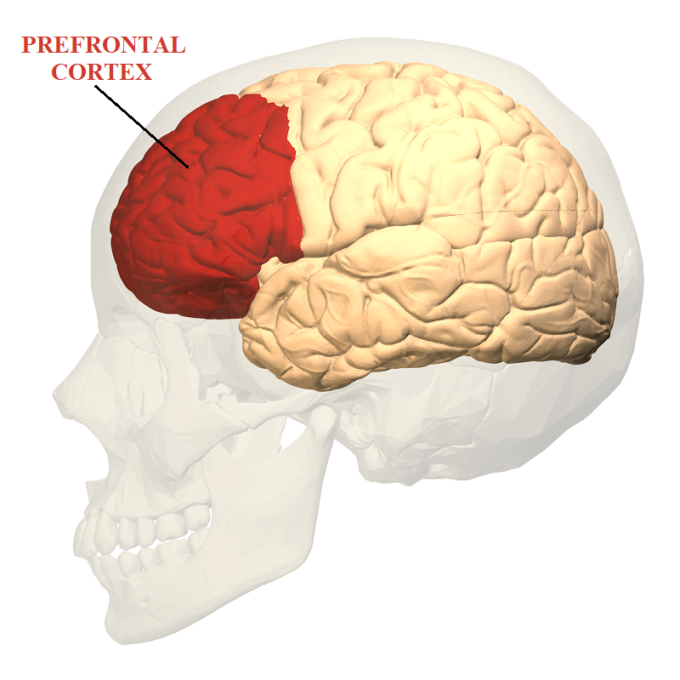
Brain imaging, as well as other studies, has confirmed a very fascinating fact. During both opioid analgesia AND the placebo analgesia, the same pre-frontal regions of the cortex, which are rich in opioid receptors, are activated (Holden, 2002; Ramos, 2007; Lui et al., 2010). The pre-frontal cortex controls our emotions, abstract thinking and reasoning, memory, attention and eventually our animal instincts. Fig. 1 illustrates the location of the pre-frontal cortex in the human brain.
Despite the similarities, there is a significant difference in the further development of events between Opioid Analgesia and the Placebo Effect. However, in the case of Opioid Analgesia the cortex elicits an inhibitory effect on the pain analyzing system, affecting the brain stem, which is a very old (evolutionarily speaking) part of the brain. In contrast, Placebo Analgesia triggers pain inhibition by engaging the ‘youngest’ parts of the brain, called the neocortex (Petrovic et al., 2010). Although the same parts of the brain are originally activated, opioids work without further cortex involvement, while Placebo Analgesia requires a much more complicated chain of events for it to be triggered. In other words, Opioid Analgesia patches the problem and requires the formation of new opioid receptors, triggering addiction, while Placebo Analgesia engages upper cortical centers, which start to rearrange the entire operation of the CNS.
NOCEBO EFFECT
We as therapists can’t talk about the Placebo Effect without addressing its counterpart, the Nocebo Effect. The Nocebo Effect, or Nocebo Hyperalgesia, is an increase in the activity of the pain analyzing system due to additional stress, anxiety or depression. Therapists regularly observe the Nocebo Effect in their practices. Patients with long-lasting chronic pain clearly exhibit anxiety, stress and depression because the long pain experience and failed therapies they went through contributed to a sense of ‘no light at the end of the tunnel.’ In such cases, existing chronic pain that comes from the affected organs or tissues is additionally amplified by the brain, creating a vicious cycle of never-ending clinical symptoms. The Neuromatrix Theory of Pain proposed by Prof. Melzack is a great explanation of the Nocebo Effect (Melzack).
The Nocebo Effect is one of the first enemies the therapist encounters when he or she starts to work on the patient with various chronic pain syndromes. The Nocebo and Placebo Effects are not only opposite in polarity, but they are also processed differently by the CNS. When the Nocebo effect is triggered, it stays longer in the CNS and continues to feed on itself, interfering with any treatment. This is why it is so important for the patient with initial acute pain not to slip into low-grade chronic pain and dysfunction which continues sometimes for years. For patients, it looks like an improvement compared to the acute pain, while in reality it is a path to more profound negative changes including triggering the Nocebo Effect. The interaction between the Placebo and Nocebo effects is well described by Kaada (1989):
“Nocebo-stimuli, such as anxiety, fear, mistrust and doubt, may reduce a placebo-effect; it may induce negative side-effects in placebo-treatment; it may produce new aversive symptoms; and it may reverse symptoms from positive ones to negative ones (e.g. revert a placebo’s analgesic response to hyperalgesia).”
MY PERSONAL CLINICAL EXPERIENCE
During my long professional career, I realized that massage therapy, when done correctly, besides having a physiological effect, also triggers a Placebo effect, and it is a very powerful healing tool. It happens because of what I call “the human factor” or a “therapist’s factor.”
Of course, the degree of Placebo activation varies from patient to patient. It is more important for patients with long-lasting chronic pain than for a patient who, let’s say, pulled his rotator cuff muscles yesterday.
Not long ago, I had a long conversation in which a very knowledgeable and experienced massage therapist told me that experiments done years ago showed that the Placebo Effect after the application of regular full-body massage therapy rose to 50%. I mean that clinical symptoms of muscle or fascial tension or periosteal changes are still there, but the patient feels fewer symptoms. 50% is a very high number, and I am sure that many massage modalities are using pure Placebo Effect to justify their clinical effectiveness. After hearing that, I replied, “In such a case, we as massage therapists are in a greatly advantageous position compared to other healthcare professionals. In addition to being able to address actual causes of somatic abnormalities, we already have a 50% improvement, which comes strictly from a Placebo Effect.”
I also noticed that when the Placebo effect is successfully triggered, my patients report very unusual feelings. Some will remark: “It was amazing, I felt something very positive happened inside of me” or “It was absolutely different, mystically different, in comparison with other treatments I had experienced.” Some of my patients suddenly experience such a great sense of relief that medical massage therapy becomes a deeply emotional experience for them. These reactions are not signs of my extra healing abilities. The combination includes detailed Evaluation, careful building of interaction with patients, a defensive approach to the affected soft tissues, complete avoidance of activation of the pain analyzing system while the patient’s CNS still rides high on the Nocebo Effect, etc. I believe that these and other factors allowed me to trigger the Placebo Effect and wake up the ‘Ultimate Doctor’ in the patient’s brain. Having this powerful physician on my side allowed me to start addressing the problem using local and reflex mechanisms of Medical Massage until stable clinical results were achieved.
I believe that healing outcomes of the Placebo Effect are the result of a dramatic increase in the electrical activities in the neocortex, and their summation eventually leads to positive changes in the function of affected organs and systems. During massage treatment, the skillful therapist uses different techniques to massively activate a variety of peripheral receptors located in the different layers of the soft tissues. Thus, besides locally normalizing the function of affected soft tissues, he or she sends massive sensory input into the CNS which mobilizes neuroplasticity of the brain and alters its electrical activity. Neuroplasticity is the ability of the brain to adjust its electrical activity as a response to repetitive sensory stimulation from peripheral receptors.
Observing the profound psychological impact Medical Massage has on patients with chronic pain in our clinic led me to believe that massage therapy activates self-healing processes inside of the patient’s brain similar to the Placebo Effect. However, in contrast with the pure Placebo Effect, which may or may not be triggered by the cortex, the brain can’t resist and can’t stay indifferent to the huge wave of sensory stimuli we are creating during massage treatment. Therefore, massage therapy has a predictable and profound effect on cortical function, and this is why patients with chronic pain see our successful treatments as emotional and even ‘mystical’ experiences.
Thus, as massage therapists, we should view Placebo as an extremely powerful clinical tool we must use to improve the health of our patients. Positive (Placebo) or negative (Nocebo) psychological triggers activate receptors in the cortex and trigger massive electrical activities within the brain. It is within our capacity, by working with peripheral receptors in the soft tissues, to alter brain electrical activity while switching the patient’s brain from Nocebo to Placebo mechanism. By doing that, we will be able to wake up the powerful Doctor Placebo within each patient, and it will help us in our clinical work.
If you are interested in purchasing a CEU program in Medical Massage including additional support and examination materials please visit: Medical Massage Education
REFERENCES
- Blakeslee S. Placebos prove so powerful even experts are surprised; new studies explore the brain’s triumph over reality. The New York Times. October 13, 1998.
- Elsenbruch S, Enck P. Placebo effects and their determinants in gastrointestinal disorders. Nat Rev Gastroenterol Hepatol. 2015;12(8):472-485. doi:10.1038/nrgastro.2015.117
- Holden C. Drugs and placebos look alike in the brain. Science. 2002;295(5557):947-947. doi:10.1126/science.295.5557.947a
- Kaada B. Nocebo—the opposite of placebo. Tidsskr Nor Laegeforen. 1989;109(7-8):814-821.
- Lui F, Colloca L, Duzzi D, Anchisi D, Benedetti F, Porro CA. Neural bases of conditioned placebo analgesia. Pain. 2010;151(3):816-824. doi:10.1016/j.pain.2010.09.021
- Meyers S, Janowitz HD. The natural history of ulcerative colitis: an analysis of the placebo response. J Clin Gastroenterol. 1989;11(1):33-37. doi:10.1097/00004836-198902000-00008
- Moerman DE. Cultural variations in the placebo effect: ulcers, anxiety, and blood pressure. Med Anthropol Q. 2000;14(1):51-72. doi:10.1525/maq.2000.14.1.51
- Petrovic P, Kalso E, Petersson KM, Andersson J, Fransson P, Ingvar M. A prefrontal non-opioid mechanism in placebo analgesia. Pain. 2010;150(1):59-65. doi:10.1016/j.pain.2010.03.011
- Ramos JM. Placebo effect and pain: brain bases. Neurologia. 2007;22(2):99-105.
Category: Medical Massage
Tags: JMS 2018 Issue #1
