
Theresa Brumble, LMT, is close to graduating from our SOMI Medical Massage Program. She recently opened her own clinic, where she actively practices MM as part of an integrative approach to somatic rehabilitation.
During the time we worked together, Theresa grew tremendously as a therapist and also as a clinician. This case she submitted to JMS is a great illustration of Theresa’s ability to gather clinical data and correctly interpret it to develop an individual treatment strategy.
MEDICAL MASSAGE vs. CHRONIC HEADACHE
This clinical case was very important to me. My patient has been my friend for more than 30 years. She has suffered from tension headaches for most of her adult life. A little more than 10 years ago, she was treated by a local neurologist who prescribed Topamax, a nerve pain reducer used to prevent migraines. She also used Relpax to treat migraines. She is very health-conscious and did not want to take prescription drugs any longer. She had been on these two drugs for more than 10 years.
She learned of my recent training with the Science of Massage Institute (SOMI) while I was treating her knee with a combination of Medical Massage and deep tissue laser. I had just received SOMI’s training for Chronic Headache due to Occipital Nerve Neuralgia, and she wanted to give it a try after having suffered for so long.
Initial Symptoms And Evaluation
My patient works from home and sits at a desk for about eight hours a day. She takes breaks periodically, but seems to always have headaches and neck pain. The pain was mostly concentrated in the upper and middle trapezius and radiated to her left shoulder and up the back of her head. Her ROM was limited in flexion and in rotation to the left.
Examination of cutaneous reflex zones
Initial evaluation of the skin using the Dermographism Test indicated an overactive parasympathetic division of the autonomic nervous system. Tissues over the upper shoulders and neck were really warm to the touch and puffy.
Examination of the connective tissue zones
Kibler’s Technique, which tests resistance to the skin’s vertical lift, indicated the presence of tension in the superficial fascia that covered the fibers of the upper and middle portions of the trapezius. Dicke’s Technique with a prominent ‘Orange Peel Sign’ confirmed the same findings on the left side along the trapezius muscle.
Examination of reflex zones in the skeletal muscles
The patient’s upper and middle portions of the left trapezius were more prominent and appeared almost swollen. Her left shoulder was elevated more than the right.
Wartenberg’s test was positive for tension in the Anterior Scalene muscle especially on the left. That can be a contributing factor to trapezius muscle tension.
Further evaluation of muscle tension confirmed the presence of active trigger points in the Trapezius, Splenius Cervicis, Multifidus, Levator Scapulae at the distal attachment and muscle belly superiorly, as well as the Splenius Capitis and the clavicular head of the Sternocleidomastoid.
Examination of periosteal reflex zones
Periosteal trigger points were active along the Superior nuchal line of the Occiput, on all spinous processes of the cervical vertebrae, as well as the spinous processes of T1-T4 and T11-T12, where the trapezius attaches.
Treatment
I began her treatment on March 26, 2018, which included deep tissue laser therapy for 4-10 minutes on the entire upper back and neck posteriorly and anteriorly. The laser protocol for headaches states: every other day for two weeks, then evaluate. I added my newfound knowledge of Occipital Nerve Neuralgia after laser therapy.
I began treating each layer of tissue with effleurage, cupping, Graston, and deeper kneading to soften the tissue. I also used electric vibration to the trapezius and erector muscles to release active trigger points. Her periosteal trigger points were very painful on the first visit, especially at the trapezius attachment to the occipital ridge. I won’t describe the MM protocol for Chronic Headache, since it can be reviewed in previous JMS publications. Here are the links:
MEDICAL MASSAGE PROTOCOL:
Treatment of secondary symptoms:
After two visits, her headaches were reduced in intensity and frequency. By visits five and six, she was happy to report she had zero headaches. However, she was still taking Topamax. After two weeks, we determined that we would extend her treatments to one time per week. She was very faithful with her homework stretching routine. We also adjusted her work environment to be ergonomically correct and made a few other adjustments.
After two weeks of once-weekly treatments, she only complained of one headache. Her periosteal trigger points were no longer active, and the tension in the trapezius was reduced substantially. At this point, we switched to one treatment every two weeks. After the second visit, she had zero headaches!
She went to her neurologist with information about our treatment and asked to come off her Topamax. The doctor started reducing her dose. We extended the interval between treatments again to six weeks due to scheduling. During that time, she came totally off Topamax and substantially reduced her Relpax, which she took only as needed and occasionally replaced with Tylenol.
Outcome
She now sees me for maintenance visits every six weeks. She is off her Topamax and uses Tylenol for intermittent headaches. There is no original tension in fascia as well as reflex zones in the skeletal muscles (especially trapezius) and periosteum. Both divisions of her autonomic nervous system are now balanced. She may have an occasional headache now and then, but they are usually from sinus issues.
I was so very grateful to be able to use my knowledge to help my dear friend! Thank you so much. I have the utmost respect for Dr. Ross Turchaninov for bringing this knowledge to the United States and sharing it with us. We are all now better equipped to help our patients out of pain! I’m so grateful to have had the opportunity to learn and continue to learn from him!
ABOUT THE AUTHOR
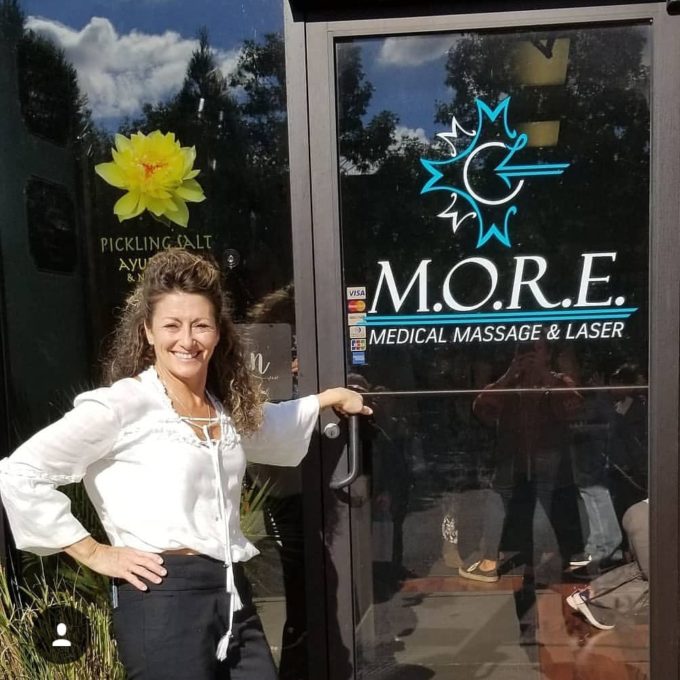
Theresa M. Brumble, RT(R)(CT), LMT, LLLT
Theresa Brumble is a Licensed Massage Therapist from Northfield, NJ. She worked previously as a CAT scan/MRI technologist for 20 years. Finally, she realized that she could help patients more, and she went to massage therapy school. She quickly realized that she wanted to be on the therapeutic or medical side of bodywork.
“I purchased a Class IV Deep tissue laser for pain over 2 years ago and that changed my practice, but I didn’t realize until I went to my first SOMI Medical Massage seminar that I could actually improve the quality of life for my patients! I now use MEDICAL MASSAGE PROTOCOLS combined with deep tissue laser to help people in pain! I have been able to rid people of decades of headaches. I have helped to rehabilitate shoulders, knees and other joints quicker after surgery. I have even kept people from surgery. I use MEDICAL MASSAGE PROTOCOLS to reverse herniated discs in the lumbar spine. I have worked with patients from 9 – 91 years of age. Medical Massage incorporates Lymphatic Drainage, Therapeutic Massage, Trigger Point Therapy, Cupping, Vibration and Stretching Techniques, etc., to rejuvenate each layer of tissue! The laser reduces inflammation, increases blood flow and heals on a cellular level! The two combined are amazing for all sorts of pain!
I just opened my new office, MORE Medical Massage and Laser in Somers Point. I have a few classes left before I am the only Certified Medical Massage Practitioner in the area! I am so excited to start this new chapter helping people out of pain!”
Category: Case Studies
Tags: JMS 2018 Issue #4
