
This clinical case was presented to the Science of Massage Institute by Jennifer Chason, who is the newest graduate of our Medical Massage Certification Program. Jennifer’s ability to conduct a detailed clinical evaluation and her excellent clinical observation skills stand out in this case. While training the therapists in Medical Massage, we emphasize two important points:
- Always know the source of innervation of the soft tissues the therapist works with.
- Continually read and correctly interpret signs and signals the body exhibits during the evaluation and treatment session.
Jennifer did precisely that, allowing her to eliminate the patient’s eight-year history of chronic suffering. Let’s pause for a second: on one side, eight years of pain, endless medical testing, different procedures including surgery and various medications, and on the other side, ten sessions of Medical Massage Therapy! Thank you, Jennifer, for all your efforts to master Medical Massage therapy, and now it pays off beautifully!
MEDICAL MASSAGE vs. CHRONIC MIDDLE BACK PAIN WITH INTERCOSTAL NERVE NEURALGIA
The patient is a 55-year-old male who works as an IT manager.
COMPLAINTS
The patient experienced pain wrapping around the anterior ribs and “knife-like” pain under the edge of the rib cage on the left. He experienced shortness of breath (SOB) when the pain was at its worst, and the pain sometimes spreads to the shoulder. The pain level often gets to 7-8/10 but is not that bad every day. The SOB is not tied to exertion. His pain begins within moments of getting up in the morning but will stop within minutes if he lies down. Work (walking on an incline or stairs, standing to cook, etc.) exacerbates it, and driving or even riding in a car for 10 minutes will cause a quick flare-up.
CLINICAL HISTORY
The patient works long hours as an IT manager, but his job requires varied tasks. His problem originated eight years ago while he was driving. He felt a sudden sharp pain in his left abdomen that got progressively worse.
He has given up driving the car and has difficulty driving his truck on longer trips. Moving around at work seems to help a bit sometimes. He reported no pain when coughing, sneezing, or deep breathing. The chronic pain he experienced dramatically affected the quality of his life for eight years!
During these eight years, the patient had extensive medical testing: X-ray, CT, MRI, colonoscopy, breathing study, and laparoscopic abdominal surgery, which ruled out abdominal and thoracic disorders which may trigger his symptoms. Also, he had spinal fusion at the L4-L5 level to eliminate radiating leg pain due to intervertebral disk degeneration. Six years ago, he also had cervical fusion at the C5-C6 and C6-C7 levels due to pain/tingling/numbness in the left arm. All these surgeries didn’t change his left trunk pain.
Finally, to control his lateral trunk pain six months before our first meeting, an electric nerve stimulator was implanted at the T5 level. However, the patient didn’t notice the difference.
The patient had numerous physical therapy sessions without any improvement. Also, he tried massage therapy and saw that it brought a couple of hours of relief, but the pain returned with the same intensity.
INITIAL EVALUATION
Chronic muscle spasm on the left side is visible, so the skin with superficial fascia is drawn into a crease on the left side of the body below the armpit. Fig. 1 illustrates visual observation.
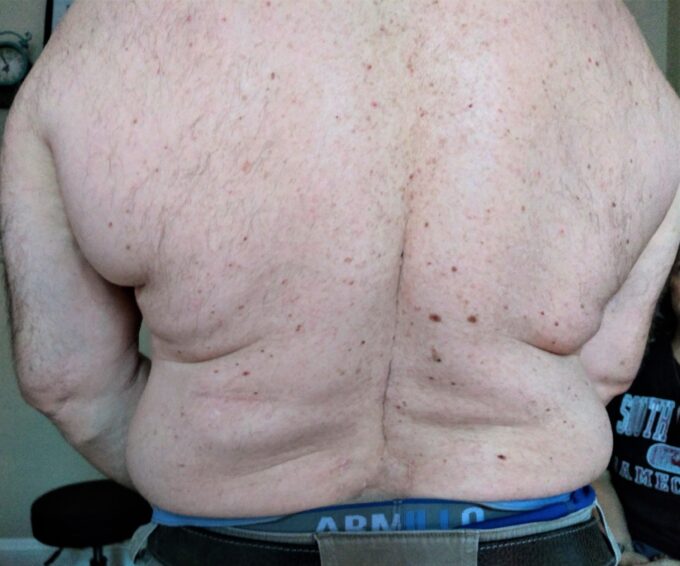
General skin thickness in this area was so intense that it was impossible to use Dicke’s technique to examine the mobility of the fascia. The patient didn’t exhibit abnormal dermographism reactions or pain along the spine.
The soft tissues in the patient’s left neck looked and felt tight and restricted, but Wartenberg’s Test was negative. Compression Tests for the pectoralis minor muscle and posterior cervical muscles were also negative. All these tests ruled out the irritation of the brachial plexus on the anterior neck and shoulder. Finally, examination of the cervical spine with a vertical compression test didn’t indicate spinal nerve compression or irritation. Active ROM in both shoulders was normal and pain-free.
Erector spinae muscles were not particularly tender, but the left latissimus dorsi and especially serratus anterior muscles harbored active trigger points that elicited a Jump Sign with even gentle palpation. That explained the deep crease on the left side of the patient’s body below the armpit (see Fig. 1). Palpatory examination of the diaphragm along its insertion indicated a very painful anterior ribcage. The patient’s rib pain corresponded with T7-T8 dermatomes and sometimes may radiate to the level of T10.
MEDICAL MASSAGE PROTOCOL
As a first step, I decided to focus on the neck/shoulder muscles since just being upright and under normal gravity initiated his trunk and abdominal pain. As the evaluation showed, the lower cervical and upper thoracic myotomes were involved, with the latissimus dorsi and serratus anterior muscles most affected. Also, my evaluation indicated that the patient had symptoms of T7 intercostal nerve neuralgia with possible diaphragm spasm developed as a secondary reaction. I decided that my treatment strategy would reduce tension in the cervical and middle back paravertebral and postural muscles of the neck and upper back. I planned to add Medical Massage Protocol for Intercostal Nerve Neuralgia later.
Session 1
The patient’s pain level was moderate (6/10), and it radiated to the anterior ribcage and left shoulder. My first goal for the session was to control the pain and tension in the cervical and middle back muscles, including scalene muscles. Although Wartenberg’s test was negative, the tension in the anterior neck was visible.
I started with the inhibitory regime of massage therapy for the scalene muscles and trapezius, focusing on C7-T7 spinal segments. I used the technique for the relaxation of the cervical paravertebral muscles and later added Sherbak’s friction on the lateral surfaces of spinous processes of C7-T1. While working on the scalene muscles using the inhibitory regime, I detected a taut band of fibers in the middle scalene muscle. As soon as I applied even mild pressure during inhibitory strokes, the patient reported that pain radiated toward his left ear. I worked on the middle scalene using very gentle circular frictions, Myofascial Release Technique, and passive local stretch.
Next, I turned the patient into a side-lying position and started to address latissimus and serratus anterior muscles, first using permanent electric vibration to prepare the muscles for Trigger Point Therapy. However, in less than 60 seconds, a large welt appeared at the site of vibration. I discontinued the vibration and used lymph drainage massage strokes to reduce the welt. I finished the treatment with passive stretching for serratus anterior and latissimus dorsi muscles.
After the session, I continued to think about the thick band of fibers I found in the middle scalene muscle and the immediate pain radiation toward the patient’s ear. I concluded that this is critical information because if the middle scalene muscle is tense, it may irritate the brachial plexus, especially the part which gives origin to the long thoracic nerve and nearby passing thoracodorsal nerve. They originate from C7; the long thoracic nerve innervates the serratus anterior muscle, and the thoracodorsal nerve innervates the latissimus dorsi muscle.
Chronic irritation and mild inflammation of these nerves are more likely causes of the patient’s spasm and active trigger point formation in the left serratus anterior and latissimus dorsi muscles. I didn’t rule out Intercostal Nerve Neuralgia completely, but I started to think that acute spasm in the serratus anterior and latissimus dorsi is the actual trigger of his lower rib and abdominal pain. That explained why the patient didn’t feel any pain during sneezing and coughing, which are the first clinical indicators of Intercostal Nerve Neuralgia of any location. So, I decided to focus on decompression of the middle scalene muscle and elimination of active trigger points.
Sessions 2-5
I saw the patient three times per week for two weeks. I focused on the scalenes, especially the middle scalene muscle, as a possible trigger of irritation of long thoracic and thoracodorsal nerves. At the same time, I concentrated on paravertebrals at the C3-T1 levels to eliminate any possible nerve root irritation of the spinal nerves responsible for the innervation of the middle scalene muscle.
Medical Massage sessions included:
- Inhibitory regime massage for neck and entire upper back.
- Relaxation of the paravertebral muscles at the C3-T1 levels.
- Sherbak’s Frictions C5-T8.
- Scalene protocol.
- Skin kneading or cupping over rib cage to address reflex zones in the skin and fascia.
- Trigger Point Therapy and Postisometric Muscular Relaxation for the latissimus and serratus anterior muscles.
- Frictions between and along ribs (portions of Intercostal Nerve Neuralgia protocol).
- Frictions under the edge of the ribcage.
- Techniques of diaphragm stretching during the patient’s respirations.
The patient didn’t exhibit discomfort when I worked on the Intercostals, and it supported my idea that Intercostal Nerve Neuralgia is not the initial cause of the patient’s symptoms. The trigger points in the latissimus dorsi muscle resolved first, and I continued to work on trigger points I found in bands of the serratus anterior muscle.
I gave the patient homework: gentle neck self-stretches to relax the scalenes and self-stretches for the latissimus and serratus anterior muscles.
After the sessions, the patient had immediate relief (a reaction similar to that after previous regular massage sessions) with pain coming back. However, he noticed that he started to have some longer times without pain with re-application of the Medical Massage. Before one of the sessions, he had worked a 13-hour day, but he was pain-free the following day and at the start of our session, his pain level was only 2/10.
Sessions 6-10
Session 6 was a milestone. The patient reported having been up for over 2 hours before realizing he was pain-free for the first time in eight years! After the session, I did not see him for ten days since he went on vacation with his family, but his pain was very mild all that time. He started to enjoy regular daily activities with only mild, sometimes moderate pain and discomfort.
I saw him 2-3 times per week for four more sessions. I used the same treatment strategy. After session #10, I decided to try an extended break.
Later sessions
The patient was able to go six weeks with occasional but manageable mild to moderate pain. I saw him for three series of 2-3 sessions/week over five months. Although stress can bring on a “bad” day, the patient described his improvement as “night and day”. I used the same protocol but started to add Periosteal Massage at the insertions of the affected muscles.
Adjustments to the course of treatment
The patient still experiences a rare “bad” day with pain around 6/10, and the SOB is rare but happens. This may reflect the anxiety-related activation of Serratus Anterior trigger points noted by Travell and Simons (Vol. 1, p. 892). After consulting with Dr. Ross Turchaninov, I started to believe that underlying rib misalignment and intercostal nerve neuralgia due to the initial spasm in the serratus anterior muscle may contribute to his residual symptoms. The Medical Massage protocol I used has addressed the initial trigger by decompressing the posterior neck and scalene muscles, but rib misalignment due to the residual tension in the serratus anterior muscle is an independent problem.
At the last visit, I closely evaluated the intercostals and found pain near the spinous process of T8 and the eighth intercostal space. The intercostal spaces (T7, T8, and T9) are very narrow. In hindsight, I should have evaluated the ribs more carefully initially. I did not realize the postural role of intercostal muscles. Now I know the intercostals have a postural function, and I finally realized the connection between gravity-induced pain and compromised intercostal spaces. From that perspective, I think that I am on the right path. Currently, I use the protocol for Intercostal Nerve Neuralgia to decompress intercostal spaces as a final piece of the puzzle.
ABOUT THE AUTHOR

Jennifer Chason, MS, LMBT, CMMP
As a former biologist, I have always been fascinated by the natural world. But after 10 years in environmental science, I found myself drawn to working more closely with people and soon trained as a massage therapist. I have since spent 22 years doing massage in a variety of settings, but primarily in hospital-based practices in North and South Carolina.
Doing wellness and therapeutic massage over the years was rewarding, but the goal of getting clinically stable results was elusive. I always valued and tried to practice clinical methods, but something was missing. In addition to my practice, I have also taught an entry-level (science-based) massage program at the local community college for the past 10 years.
At some point in this journey, I found the Science of Massage Institute, and the missing pieces started to materialize. I explored the video library, read the journal, and followed Dr. Ross Turchaninov for years. I applied information gleaned as best I could with my clients. And I utilized SOMI in the classroom to provide a solid foundation in the science of massage and how massage actually works.
Wanting to be a more effective therapist, I finally embarked on the Medical Massage Certification process. After much learning—and unlearning—I am proud to be certified by SOMI! I wish someone had introduced medical massage to me when I was in school, so I plan to continue doing that for my students. I work alongside a former student who specializes in manual lymphatic drainage, and we are building a thriving clinical practice in Spartanburg, SC. I will continue to study with Dr. Ross Turchaninov and Dr. Cullers as often as possible as I continue to learn. Thank you, Dr. Ross Turchaninov, and everyone at SOMI for this new chapter in my career!
To contact the MassageNetics clinic, please use the phone number 864-214-5963 or our website: MassageNetics | Lymphatic & Therapeutic Massage Spartanburg SC
Category: Case Studies
Tags: JMS 2022 Issue #1
