
In every issue of our journal, you will find a Case of the Month, which we will select from among the submitted cases. Everyone who is using MEDICAL MASSAGE PROTOCOLS in their practice may submit their cases for review, and we will share with our readers the best one in every new issue.
This Case of the Month is an outstanding contribution. I hope that readers will greatly appreciate this story of professional success. This contribution illustrates how far massage practitioners can go to help clients if they have the right tools and scientifically based protocols.
In his initial e-mail, Juan informed us that he plays the videos from the MEDICAL MASSAGE PROTOCOLS in his therapy room while he works on his clients. This is the exact way we envisioned the use of our Video Library. This submission is a great example of the science of massage at work.
COMPLEX CASE OF LUMBALGIA (LOWER BACK PAIN) AND PERIPHERAL NERVES PATHOLOGY
The client is male, 44 years old, and works as a contractor in the construction business.
Clinical History
The first clinical symptoms appeared 18 months ago in his lower back, both lower extremities (especially the left one) and later in the neck and left upper extremity as well. The intensity of the clinical symptoms varied depending on the level of stress and daily workload.
Previously, he had had three left knee surgeries to restore the anterior cruciate ligament. His last surgery was in 1993.
The patient was depressed because of the intensity of the pain and a significant decrease in the range of motion. He had difficulty bending, picking up any object and even getting up from the bed. He said that he felt like a very old man. The constant pain wore him out to the degree that he didn’t have enough energy for all of the work he needed to do in his business. He had used strong pain medications for the previous 18 months.
He regularly saw his doctor, but the prescribed treatment didn’t provide stable clinical results.
Initial Complaints and Clinical Symptoms
At the beginning, the pain appeared during long rides in a car. Later, the client started to feel intense pain for the entire day. The mornings were especially difficult due to very intense stiffness and muscle weakness in the lower back.
1. Examination of the lower back
The Sensory Test showed a sensory deficit along the L4-L5 dermatomes, especially on the left side. The evaluation of the skeletal muscles showed active trigger points in the lumbar erectors and quadratus lumborum muscles. The client estimated the intensity of the lower back pain at around 9-10 on a scale of 1 to 10.
He also complained about cramps in the gastrocnemius muscle on both sides, and on the plantar surface of the left foot, and pain in the area of the left Achilles tendon. The client did not sleep well and usually woke up several times per night. During the initial examination, the pain radiated along the L4-L5 dermatomes.
He also exhibited signs of peripheral edema in both legs and feet. Edema was especially prominent on the left leg.
2. Examination of the neck
The client felt numbness and pain in the left forearm and hand. Pain radiated to the left arm with a sensory deficit in the sensory alarm areas of the C6, C7 and C8 dermatomes. The client also noticed a headache.
During the examination, he exhibited active trigger points in the anterior scalene, trapezius, levator scapulae and semispinalis capitis muscles.
The Sensory Test showed the sensory deficit along the distribution of the radial and ulnar nerves. The Motor Test showed significant weakness in the left forearm and hand, especially in hand and thumb prehension.
Treatment
Overall, I used 14 sessions of MEDICAL MASSAGE PROTOCOLS. Each session was 30 minutes or one hour long. I conducted the first 6 sessions every other day, then gave a 4-day break in treatment to get a clear clinical picture. Next, I started a series of 3 sessions every third day and gave a 10-day rest after this. After the break, I used 2 sessions every third day, gave a 2-week rest and then gave 3 sessions every four days.
Sessions 1-2 (Every other day)
I used the MEDICAL MASSAGE PROTOCOLS from the Video Library. At the beginning, I concentrated on the area of the most intense clinical symptoms – the lower back. I used the MEDICAL MASSAGE PROTOCOL for the Lower Back Pain Due to Tension in the Erector Muscles – Video Library Protocol.
During the second session, I added the MEDICAL MASSAGE PROTOCOL for the Cervicocranialgia – Video Library Protocol to balance the Sympathetic and Parasympathetic divisions of the autonomic nervous system and reduce the intensity of the headache.
After the first two sessions, the patient felt great relief from the pain, especially in the lower back. On a scale of 1 to 10, he felt the pain was around 5 in the lower back and around 8 in the neck. During the first session, the client needed assistance to get on the table and had a lot of difficulty undressing himself. After the first two sessions, it was not an issue anymore.
Sessions 3 to 6 (Every other day)
I still concentrated on the lower back pain in order to continue the improvement. Besides the MEDICAL MASSAGE PROTOCOL for the lumbar erectors, I decided to add the protocol for the Lower Back Pain Due to Tension in the Quadratus Lumborum (QL) Muscle – Video Library Protocol.
After the fourth session, the client mentioned that the lower back pain was down to level 3 from the previous level 5. He was able to get on and off the table more easily and undress without help. When I palpated the lower back area, the intensity of pain and tension in the lumbar erectors and QL muscles had significantly decreased. I recommended that he do some light repetitive exercises and back stretches and walk for 25 or 30 minutes every other day.
The headache disappeared, but the cervical pain and its radiation to the upper extremities remained at the same level of 8.
Sessions 7-9 (Continued after 4 days of rest and treatments conducted every third day)
Considering that the client still had cervical pain with continued radiation, I decided to concentrate on the posterior and anterior neck. I used the MEDICAL MASSAGE PROTOCOL for the Anterior Scalene Muscle Syndrome – Video Library Protocol (7th and 8th sessions) and later added the protocol for the Ulnar Nerve Neuralgia – Video Library Protocol (9th session).
After the 9th session, the patient felt great relief from pain and a restoration of muscle strength. The Motor Test showed equal force of hand prehension on the left and right. He still felt a moderately uncomfortable sensation during palpation of the trigger point area in the ASM.
Sessions 10 to 14 (Started after two weeks of rest and treatments conducted every third day)
I started treatment with a re-evaluation of all areas. To address the residual symptoms on the upper extremity I used MEDICAL MASSAGE PROTOCOLS for the Anterior Scalene Muscle Syndrome – Video Library Protocol, Radial Nerve Neuralgia – Video Library Protocol and Ulnar Nerve Neuralgia – Video Library Protocol.
At the end of the 14th session, the pain and numbness in the left forearm and hand had disappeared and normal sleep had been restored. The client got his energy back and he hadn’t taken any medications.
Today, 85% of the original clinical symptoms are gone. He still has mild pain on the anterior and posterior surfaces of the left forearm along the C6, C7 and C8 dermatomes, along with some muscle weakness in the left forearm and hand. The symptoms continue to fade away.
Currently I see the patient every 30 days to maintain what we have gained. I recommended that the patient change some everyday habits, like long driving (more than 1.5 hours) without rest and stretching, long work on the computer, etc.
ABOUT THE AUTHOR
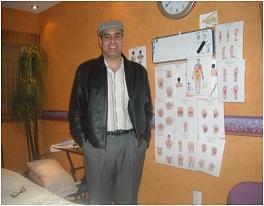
Juan Luis Ordaz Sabag, LMT
Juan Luis Ordaz Sabag, LMT, graduated from Veterinary University in Mexico in 1987. For more than 16 years, he worked as a veterinarian for Tyson Food Corporation. However, massage and bodywork were his passion and he has been studying massage therapy since 2001. Finally, he decided to change his profession and dedicate all his time to helping people in pain.
He used different techniques from books and DVDs to help his clients who suffered from pain and other somatic abnormalities. He combined Reflexology, Therapeutic Massage, Reiki, Chair Massage, Vojta, and acupressure.
Six months ago, Juan started a deep study of the MEDICAL MASSAGE PROTOCOLS from the Medical Massage textbooks and Video Library. Since then, he has used MEDICAL MASSAGE PROTOCOLS daily with excellent results. In six months, he was able to build up a very successful practice in the medical massage field. Juan lives in Torreon, Mexico, with his wife and two sons.
His hobbies are Latin Dance, singing, playing guitar and skating.
Category: Case Studies
Tags: JMS 2010 Issue #1
