
This article is a follow-up to the articles about the Placebo Effect published in issues #1 (THE PLACEBO EFFECT AND ITS ROLE IN MASSAGE THERAPY. PART I) and #2 (THE PLACEBO EFFECT AND ITS ROLE IN MASSAGE THERAPY. PART II) of JMS. Initially, we planned to publish this article as a single piece, but it grew in length, and to make it reader-friendly, we decided to split it into two parts.
The goal of this article and Part II is to discuss how the patient’s brain responds to chronic pain, the mechanisms it uses to protect itself from stress and exhaustion, how to recognize these mechanisms, and how to turn the tables to overcome psychological obstacles that greatly affect treatment outcomes.
Every patient with chronic pain must deal with the constant bombardment by chronic noxious stimuli while continuing to function and control vital body functions. To protect itself, the patient’s brain may employ one or two available psychological defense mechanisms. Eight of them, very frequently, may be observed in patients with chronic somatic pain: anger, regression, hypochondria, fear, denial, projection, rationalization, and emotional instability.
The brains of patients with chronic pain, to varying degrees, employ these protective mechanisms to reduce the stress that develops secondarily. We will discuss these protective mechanisms using examples from patients in our clinic. To counter these psychological protective reactions, therapists should modify their behavior to facilitate brain recovery while working locally in the soft tissues. Sometimes, even an inappropriate tone of voice or inappropriate interactions may reinforce an already established maladaptive behavioral pattern, thereby perpetuating a chronic somatic or visceral abnormality. Thus, the initially tangled relations between therapist and patient, as depicted in the picture below, must be untangled as therapy progresses.
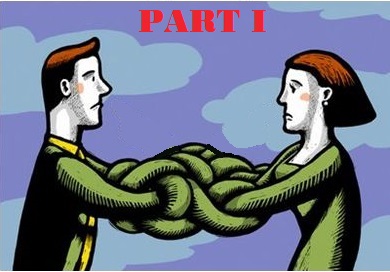
Following the publication of the two previous articles, we monitored various discussion boards and observed a striking phenomenon: some therapists deliberately disregard the psychological component of their work. Their position is elementary: “I have a patient in my therapy room with lower back pain, and it is my job to help him or her. The rest is not my business and even out of the scope of my practice.”
Such an unfortunate position is a grave mistake. We at SOMI strongly believe that therapists are making a professional mistake by trying to treat only somatic abnormalities, completely disregarding the psychological component of the chronic pain. Neither a psychologist nor a psychiatrist is present in the therapy room to assist the patient and the therapist. In such a case, the therapist’s direct responsibility is to consider the psychological component of the somatic pain they address. Thus, to achieve stable clinical results and treat the patient’s whole body instead of one pain syndrome, therapists must understand how the brain can deal with chronic pain.
It doesn’t matter if you’re a massage therapist, physical therapist, chiropractor, dentist, or physician. We all MUST consider the psychological component of our therapies, because if we don’t engage the patient’s brain appropriately and involve it in the treatment process, maladaptive patterns of behavior undermine the treatment process. Also, it would be a great mistake to see all patients with protective reactions as ‘crazy’. Each of us can be in their place if we suffer from chronic pain long enough, with no light at the end of the tunnel. Of course, what counts as ‘long enough’ differs for each patient.
Another factor readers should consider is what happens to the patient after the therapist has finished treating his or her lower back pain. In many cases, the psychosomatic component, which wasn’t addressed during the therapy, may bring the same symptoms back even though the initial therapy was successful. The patient will always seek other treatment options in such cases, even though the therapist did everything correctly. Still, he or she didn’t address the psychological component of the chronic pain the patient developed.
When I was discussing the psychological component, I didn’t mean psychological therapy, but rather the individualized adaptation of the therapist’s behavior for each patient during the necessary treatment. Thus, starting with the first meeting, the therapist must clearly understand the significant patterns of behavior exhibited by every patient with chronic pain and establish communication lines without reinforcing existing protective reactions the brain has already developed.
We illustrate how patients with different protective reactions behave and how to address them. To better illustrate the concept, we took the most expressive cases from our clinic. These cases are illustrative, yet they fit within the discussed behavioral profiles. The solution we propose for each case is based on our experience managing patients’ protective reactions.
1. ANGER
A 65-year-old retired man presented to our clinic with a clinical picture of frozen shoulder, which he had developed over the previous four months. The evaluation confirmed the presence of very advanced Adhesive Capsulitis with severe restriction of active and, more importantly, passive movements of the shoulder joint (20% passive abduction and 10% active abduction). The severe restriction of passive movements indicated a non-compliant contracture, which is extremely difficult to treat, especially in the shoulder joint.
The patient was very angry, upset, and couldn’t stop talking about how much time and money he had spent while going through different therapies, while his symptoms steadily worsened. The final solution which was offered to him was active manipulations of his shoulder by an orthopedist while he was under anesthesia, and if that failed, a shoulder replacement should be considered.
Without discussing his symptoms, it was clear that Medical Massage would likely resolve his problems, but it would require time and repetition. However, the anger the patient exhibited was a significant obstacle, since he would see our intervention as another way someone tries to make money on his shoulder problems without any results.
The patient had a legitimate right to be angry because of how long and how unsuccessful his therapies were. However, his anger had some pathological bitterness. In minute detail, he described what his PT, DC, and MT did, accompanied by almost degrading comments about the people who worked on him. It wasn’t merely general anger he exhibited, but anger as a protective reaction that developed secondarily to his long suffering.
Addressing The Psychological Component Of Somatic Pain Syndrome
His anger must be channeled into something positive and productive. There were two directions in which we needed to channel his anger: dedication to therapy and intensive homework between sessions to maintain pressure on the system and restore functions.
First, we needed to get through his defenses. The conversation must be firm yet avoid direct offense or personal criticism. Saying that everyone tried to help him as best they could wouldn’t fly since he would immediately see our clinic as ‘one of them.’ At the same time, critiquing fellow health practitioners wouldn’t be beneficial either. Instead, we began to gain his attention by agreeing to critique the medical system in general and its operations. Such a critique is acceptable because it is faceless.
We informed him of two negative experiences with insurance coverage for medical care at our clinic. As soon as his attention shifted from specific health practitioners, whom he blamed for worsening his symptoms, to the broader topic, he became highly engaged. Finally, we presented him with the worst-case scenario for his situation – full shoulder replacement. The possibility of extensive surgery if there was no correct shoulder rehabilitation caught his attention. It became apparent that now we had a chance to get through.
Next, we offered him the following agreement: No payment will be made for therapy until he begins to show signs of improvement. In return, he must dedicate all his free time to homework between sessions and be patient. The plan immediately impressed him, and he agreed.
Results
The patient started to notice improvements after six sessions. Beginning with the 7th session, as he continued to improve, he began to reimburse us for our services. At the end of the treatment, when shoulder function was restored, he insisted on paying for the first 6 sessions as well.
2. REGRESSION
Regression is a protective reaction of the brain when the patient starts to behave and act like a child. By doing that, patients ease their stress level by trying to trigger sympathy from people around them.
A 46-year-old woman works as a registered nurse. She suffers from long-lasting chronic headaches and neck pain. She also developed severe anxiety, which got worse with each flare-up of a headache. Her anxiety was so bad that it triggered various visceral abnormalities: palpitations, increased respiratory rate (tachypnea), nausea with vomiting, etc. Recently, she had been in the ER monthly and sometimes two times per month.
From the outset, the most striking observation about her was her behavior when describing her symptoms. It was unusual to see a middle-aged woman speaking in a childish voice, playing with her hair, etc. She frequently used the third person to describe the history of her symptoms. For example, she would say with a child-like voice, “Jane was a bad girl and did not take her migraine medications.”
Addressing The Psychological Component Of Somatic Pain Syndrome
Regression is the easiest protective brain reaction to overcome since the patient is already looking for people who are willing to take care of them. From this perspective, it was an easy case to handle. After the clinical evaluation, we provided her with a piece of paper and a pen and dictated all the tasks she was to perform at home. Initially, she wanted to type it on her iPhone, but we insisted on handwriting. This way, we could elicit her dedication by re-creating her youth in a school setting. Thus, she needed to write it down by herself. Each session, we began with her detailed report of how she felt and what she did at home to manage her headache and neck pain. We used a teacher’s attitude and voice, just as a teacher asks a student to do homework.
Results
After the headache and cervical pain were completely under control, the regressive behavior disappeared. She acted as any other 46-year-old woman should, fully engaged in her work as a registered nurse.
Her husband’s remarks were the most interesting reaction. Of course, he was happy that his wife was out of chronic pain, but the most important outcome of the therapy he phrased as, “I’ve got my wife back!”
3. HYPOCHONDRIA
Technically speaking, Hypochondriasis is an independent and very debilitating disease. Those patients develop an inaccurate perception of various diseases that may exist in their body, mind, or both, despite the absence of an actual medical problem. Therapists and other qualified health practitioners often fail to help these patients. Typically, hypochondriasis persists for years without any clear resolution.
However, some patients with chronic pain may exhibit the hypochondriac type of behavior, which started after they developed the initial symptoms. In these cases, the brain employs another form of self-defense to manage chronic pain.
The difference between real hypochondriacs and those patients who exhibit hypochondriac-type behavior is that the second group is looking for help, while real hypochondriacs visit any health office as a way of life. The simple distinction is the absolute absence of any improvement in the real hypochondriac and the lack of any cooperation with homework. At the same time, patients with hypochondriac-type behavior will notice and inform their therapists about any clinical improvements.
A 32-year-old very intelligent woman came to our clinic with complaints about a severe migraine-type headache she had developed in the last 2 years. She is a computer programmer and was forced to quit a year ago due to intense headaches that flare up after hours of computer work.
First, she pulled out a two-inch-thick file of her medical records and printouts from WebMD. The conversation with her appeared to be an endless chain of theories she developed, based on Internet research, about why she had a headache and why nothing helped her.
Clinical evaluation showed that she was 100% our type of patient and that we would be able to decisively help her since she exhibited all the signs and symptoms of Greater Occipital Nerve Neuralgia. However, if we had said to her, “Don’t worry, we will take care of your headache in 4-5 sessions” (which was true), there was a good chance that she would never have come back to our clinic, thinking that we were practicing quack medicine.
Her mind was already made up that something more serious and dangerous had happened to her, and that no one had been able to figure it out yet. One of her ideas was that she had a constant headache because of her childhood cardiac problem. Her foramen ovale (the opening between the atria) triggered her headache. Yes, it is a medical fact that a not fully closed foramen ovale may later in life manifest itself as a migraine-type headache; however, in her case, the opening had closed entirely in her early years.
Addressing The Psychological Component Of Somatic Pain Syndrome
Simply dismissing the patient’s theories, including the ‘cardiac theory,’ would have been completely counterproductive since it was exactly what other health practitioners, including her PCP, did. Instead, after the clinical evaluation, we asked her to leave her file and let us review it in detail later, and we rescheduled her evaluation appointment at no charge. The suggestion surprised her, since no one had even attempted to look into her carefully arranged file of Internet printouts. A quick examination of the papers in the file showed that all the data she had collected was unrelated to her problems.
At the beginning of the next session, we expressed deep gratitude for the file she brought in and acknowledged that her headache was a very serious puzzle. We suggested she try some tools Medical Massage offers and emphasized that, since her problem was very complicated, we expected only a reduction in the intensity of her symptoms. In reality, we expected complete elimination of her headache. She enthusiastically agreed because even the possibility of partial relief from the intensity of her headache was welcome news.
We insisted that, to support her better, we required her active engagement with homework, which she was to complete between sessions. We also emphasized that we needed her to start a little diary to write down how she felt after each session and between sessions. The patient was excited about this offer.
When she returned after the first session, it was evident that something positive had occurred. The next day, she experienced a severe flare-up of her headache that persisted the following day (we informed her of this possibility at the end of the first session). Still, on the morning of the second session, she noticed some improvement. It was exactly what we expected.
At this point, she pulled out her notebook, in which she had recorded, in detail, all her symptoms hourly, starting with the hour after the first session. There were pages of meticulously taken notes! I took the time to read all of them, even though they didn’t affect the treatment plan. It was evident that the patient watched as I turned page after page until the end. As soon as I finished, I told the patient that these notes were an exceptional help since they had guided me in formulating a better treatment plan.
Results
As I had planned, her headache was under complete control after approximately six sessions of MEDICAL MASSAGE PROTOCOL for Chronic Headache. She continued with supportive monthly sessions for four months before we completely discharged her from the clinic.
After one of the monthly sessions, she said she had a personal question. I answered, “Of course!” Her question was, “You knew everything from the very beginning, and you didn’t need all my notes, did you?” I answered, “Your notes made a huge contribution to the therapy, and we never would have succeeded without them.” She has been completely headache-free for more than a year.
4. FEAR
Fear is a very difficult-to-overcome brain defense mechanism. Its essence is the fear of more pain, which therapy MAY trigger. It is especially common if patients have already experienced treatment that was painful or was unsuccessful and generated more pain and dysfunction afterward. Unfortunately, it is very common, since some therapists were misled by educational sources and tried to help patients by overriding the patient’s pain threshold.
A 50-year-old patient presented to our clinic under pressure from her girlfriend, whom we had previously helped. Witnessing her miserable state, her girlfriend convinced her and drove her to the clinic. The patient requested that she be present in the therapy room.
The patient was in visible distress, and her main complaint was severe neck pain, which triggered very severe peripheral neuropathy within the radial and median nerve distribution. She had been in therapy for several months with a massage therapist, a chiropractor, an acupuncturist, and a physical therapist. At that time, she used only medications and acupuncture, since this combination helped her control pain intensity, although without stable clinical results. All other treatments had significantly worsened her symptoms, and it took her weeks to recover.
The patient’s first question was whether our therapy would hurt her, and even asking that made her emotional. During the evaluation, even a light touch triggered fear in her, and she held her girlfriend’s hand. Thus, the fear generated by her brain as a defense mechanism was the first enemy, and its elimination was the first critical step in therapy.
Addressing The Psychological Component Of Somatic Pain Syndrome
The only solution in this situation was:
- We informed her that SHE would be in complete control of the treatment and that it would be done only within her comfort level.
- Before the first therapy session began, we divided it into three segments, numbered them, and briefly demonstrated our techniques.
- We insisted that she attend therapy with her girlfriend or a family member at the beginning of treatment.
During the initial 15-20-minute sessions, we used only drainage strokes, an inhibitory massage regimen, and gentle passive stretching. Before initiating each treatment segment of the therapy, we clearly announced it. For example, “I am starting segment #2.”
Results
There was no way that this basic treatment would reduce symptom severity. Still, three sessions with two-day breaks achieved the first breakthrough: we removed fear from her mind, allowing us to apply the full Medical Massage protocol afterward. Considering the intensity of her symptoms, it took us nine sessions to eliminate cervical dysfunction and peripheral neurologic symptoms.
In Part II, we will discuss clinical cases of protective mechanisms that the brain develops in response to chronic pain: denial, projection, rationalization, and emotional instability.
Category: Medical Massage
Tags: JMS 2018 Issue #3
