
MASSAGE TODAY

How the Human Body Responds to Stress. Massage Today 19(1), 2019
The author continues to discuss an important subject – the impact of stress on the human body. In contrast with the previous piece, which was pure nonsense and was published in December of 2018, in this article the author raises important aspects of somatic rehabilitation, for example, the role of the phrenic nerve as a bridge between the somatic and visceral systems and the presence of viscerosomatic reflexes. At the same time, unscientific claims by the author continue to be present, and their only justification is the author’s references to his own publications in Massage Today. It is very sad when misleading information is supported by the author’s previously published misleading pieces cited as legitimate reference material.
Multiarticulate Muscles & Injury: Understanding the Mechanical Load. Massage Today 19(1), 2019
A good, but very basic article on types of muscle contraction and workload.
Testing The Collateral Ligaments Of The Thumb. Massage Today 19(2), 2019
Yes, the tests the author suggested for examining the collateral ligaments of the thumb are correct. However, the article leaves the impression that these tests indicate only damage to the collateral ligaments, and this is a completely incorrect assumption. These tests will be positive in the exact same way if the patient suffers from osteoarthritis of the thumb’s joints or from inflammation of the periosteum (i.e., periostitis). Thus, it is clinically incorrect to link these tests only to strain or damage of the collateral ligaments, as was suggested in the article.
What is Orthopedic Massage & Integrated Manual Therapy? Massage Today 19(2), 2019
The article touches on an important subject, but it is extremely general when it discusses the clinical aspects of MT. However, the likely reason is that it is an introductory piece, as announced by Massage Today.
An Overlooked Tool for Musculoskeletal Injuries. Massage Today 19(2), 2019
A very good article on the rarely mentioned subject of electric vibration as a tool to decrease muscle tension, diminish protective muscle spasm and maintain proprioception. We may also add that there are two types of vibration which affect our body and muscle tension differently. Since Pacinian corpuscles (i.e., receptors which detect vibration) are rapidly adapting receptors, fixed true vibration will decrease muscle tone, while mobile, percussion-type vibration will slightly increase muscle tone. In a clinical setting, fixed true vibration is used, for example, as preparation for Trigger Point Therapy, while percussion-type mobile vibration is an excellent tool for soft tissue rehabilitation in patients after strokes or with peripheral neuropathy.
The Structure of the Foot-The Key to Rehab. Massage Today 19(2), 2019
The author correctly describes a local case of plantar fasciitis due to trauma and overload in young athletes and its local treatment.
How to Reduce Metabolic Endotoxemia. Massage Today 19(2), 2019
A good educational article in regard to endotoxemia.

New Replacement – New Problems. Massage Today 19(3), 2019
We gave such a strange rating to the article because on the one hand the author is completely correct, but at the same time she makes a generalization mistake similar to the one she critiques.
In short, knee and hip joint replacements have indeed reached epidemic proportions. The author is also partially correct when she talks about the moment when joint replacement surgery was first recommended to patients.
“None of these physicians are taking the time to look at the real cause of the issue [i.e., joint pathology, by JMS]”
We said ‘partially’ because there are many responsible orthopedic surgeons who are doing a great job of postponing joint replacement surgery as long as possible, until it is absolutely necessary. Thus, ‘none of these physicians’ is an overreach. However, the author is correct when she mentions a large number of completely unnecessary surgeries which can be prevented by therapists who should detect and address the initial trigger which may mimic joint pain and dysfunction. The author provides her own clinical cases as illustrations, and she is correct again. Indeed, a difference in the length of the lower extremities may contribute to, trigger or mimic joint degeneration. The author deserves credit for her passion for the profession and for not being afraid to speak out.
So, why does the same article also have two bad apples? We wanted to fully acknowledge the author’s professional skills and dedication first and then separately discuss the mistake in generalization she made in the last section of the article, “My Conclusion.”
In this section, the author, based on her own clinical experience, concludes that the difference in length between the two lower extremities is a conclusive factor in the therapist’s decision to address the soft tissue abnormalities first and thus prevent knee or hip joint replacement surgery in the future. This is an incorrect and professionally risky generalization.
Yes, for some patients, a difference in the length of the lower extremities is a sign that its correction will restore the biomechanical functions of the joint, and by unloading pressure, therapists may save the patient from unnecessary surgery. However, all patients with severe destruction of the cartilage and subchondral bone, due to Osteoarthritis (OA), will always exhibit shortening of one leg. Let us illustrate this point, since it was completely missed in the article.
Fig. 1 illustrates an X-ray of a normal left hip joint. Pay attention to the empty space between the tip of the femoral head and the acetabulum (the space between the two small red lines). In the real joint, this space isn’t empty but is filled with cartilage, which covers both bones and is translucent to X-rays. You may split this space in two: the upper half is cartilage that covers the acetabulum, and the lower half is cartilage that covers the head of the femur.
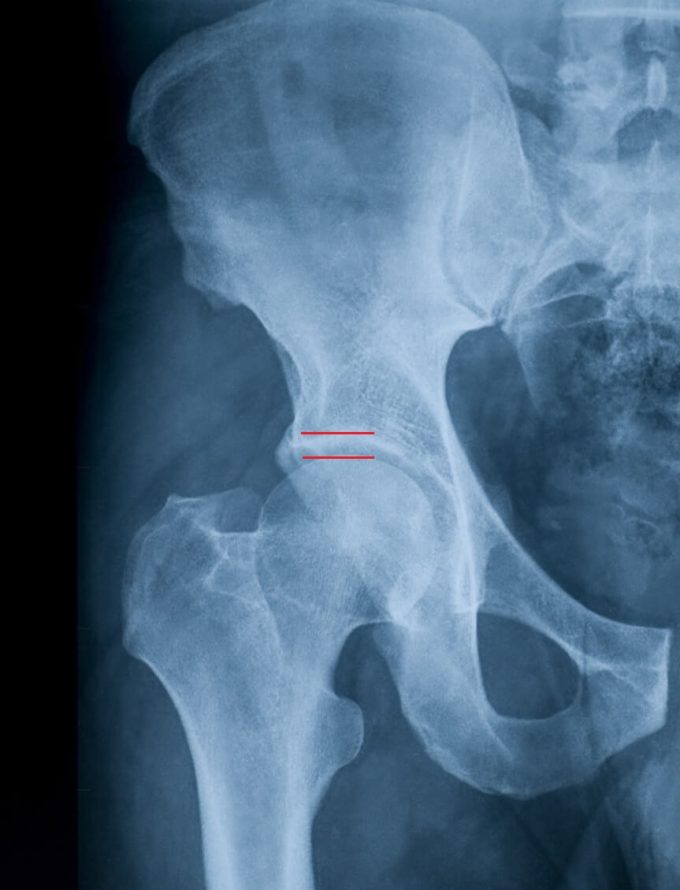
Fig. 2 illustrates an X-ray of the entire pelvis and normal hip joints. Pay attention to the red line, which indicates that both joints are at the same level and there is no difference in the length of the two extremities.
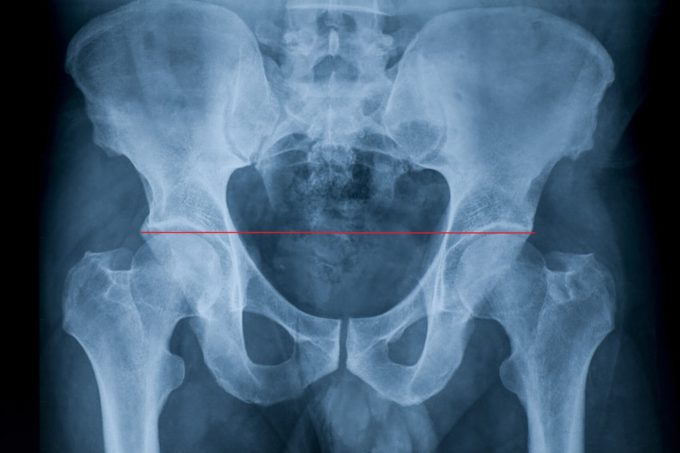
Fig. 3 illustrates the X-ray picture of severe right hip joint destruction due to osteoarthritis. All cartilage is gone due to complete degeneration of the hip joint (no space between the two bones), and please also notice the proximal displacement of the entire right femur (the tip of the femoral head is above the red horizontal line, at the level of the blue line).
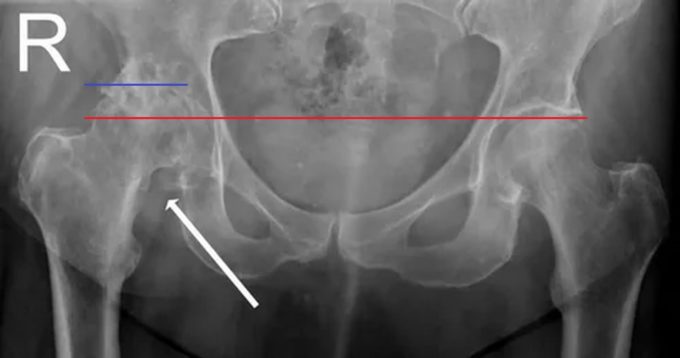
Fig. 4 illustrates an X-ray picture of left Hip Dysplasia, which sometimes can be missed in infancy; the left femur is now displaced proximally, with the tip of the femoral head also above the horizontal red line, at the level of the blue line.
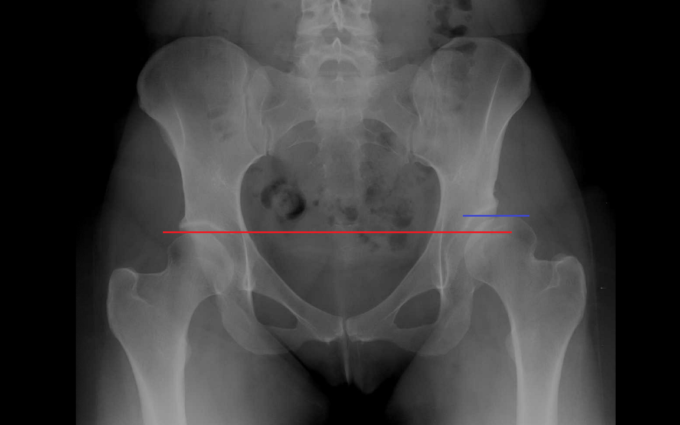
Both patients illustrated in Fig. 3 and Fig. 4 will exhibit the same clinical symptom of a shorter leg on the right and left sides, respectively. If the therapist acts according to the recommendations from the article and promises results by working with the soft tissues with the goal of restoring the length of both extremities, he or she will mislead the patient and deceitfully take payment, since the only solution is full hip replacement for the patient illustrated in Fig. 3 and corrective surgery or hip replacement for the patient in Fig. 4.
Our Conclusion: measure the length of both extremities, but never consider a difference in length a decisive factor in promising stable clinical results. It may work for some patients, such as those mentioned in the article, but it can also be a waste of your time and reputation, as well as the patient’s money, as we illustrated with clinical cases that are frequently observed. A difference in the length of the lower extremities must be examined with other tests and evaluations to prevent treatment mistakes.
Myofascial Release, The Missing Link. Massage Today 19(3), 2019
A very good article.
Understanding The Proprioceptors. Massage Today 19(3), 2019
A very good article!
Visceral Lymphatic Balancing Techniques. Massage Today 19(3), 2019
This article sounds like a promotional piece for seminar enrollment rather than a clinical or educational piece.
Treating the Untouchables. Massage Today 19(3), 2019
This article generally discusses Neural Reset Therapy (NRT) and promotes seminars. NRT is a legitimate part of somatic rehabilitation, which unfortunately is seen by some as a silver bullet for successful rehabilitation. It should be part of the treatment process. There are different ways to engage the H-reflex, which is associated with a short-lived decrease in muscle tone. They have been very well known and studied clinical tools since the 1960s. NRT is a very easy and helpful way for therapists to use this reflex as part of the treatment process. Please view NRT from this perspective, as a tool that works with other modalities, rather than as the ultimate answer to stable clinical results.
How the Human Body Responds to Stress (Part 2). Massage Today 19(3), 2019
Mr. Alexander continues to spread his ideas, which don’t exhibit common sense or physiological grounding. There is nothing to add about this piece, since we already reviewed Part I above in this issue of JMS.
MASSAGE & BODYWORK MAGAZINE
Temporomandibular Joint Disorders. Biting Off More Than We Can Chew. Massage & Bodywork Magazine, Jan-Feb, 2019
This article is a basic discussion of TMJ dysfunction, and it barely touches on treatment options. However, to be fair, the author mentions that this is an introductory article. Another aspect of TMJ dysfunction is completely missed. When the author discussed the causes of TMJ dysfunction, mild irritation of the minor occipital nerve was not even mentioned, even though this is one of the most common hidden initial triggers.
Trapezius. Massage & Bodywork Magazine, Jan-Feb, 2019
A good article about the anatomy, function and palpation of the trapezius muscle.
Palpation of the Psoas Major. Massage & Bodywork Magazine, Jan-Feb, 2019
An excellent article which reviews all approaches to the examination of abdominal and extra-abdominal parts of the psoas muscle. Excellent illustrations.
THE COBRA AT YOUR CORE. The Psoas-Diaphragm Connection. Massage & Bodywork Magazine, Jan-Feb, 2019
A great article about linking different somatic structures into one physiological chain, from the diaphragm via the psoas all the way to the hip joint.
Wild Psoas. Eco-Messenger for Thriving. Massage & Bodywork Magazine, Jan-Feb, 2019
A very unusual view of the psoas and somatic integrity in general.
Spondylolysis and Spondylolisthesis. A Slippery Slope with Back Disorders. Massage & Bodywork Magazine, Jan-Feb, 2019
A very good article, especially in regard to Spondylolisthesis. Some therapists are not aware of this complex condition and can aggravate its symptoms while trying to help a client.
Bones as Levers. Tips to Treat Back Contractures and Spasm. Massage & Bodywork Magazine, Jan-Feb, 2019
A very good article!
MASSAGE MAGAZINE
Cupping As Manual Therapy. Massage Magazine, 273, Feb. 2019
A very good introductory article. We especially like the notion that cupping is presented as a part of rehabilitation.
Assisted Stretching. Massage Magazine, 273, Feb. 2019
This is a very basic article on a very important subject. The author reviews the main types of Assisted Stretching. She describes some and for some reason misses the most clinically important one for therapists: Postisometric Muscular Relaxation (PIR).
MASSAGE THERAPY JOURNAL
Massage and Orthopedic Pathologies. MTJ, Winter 2018
There is no doubt that this article touches on an important subject, since MT is indeed an irreplaceable tool for orthopedic doctors to use in conjunction with their work. MT can decisively restore function, help prepare tissues for surgery and dramatically speed up recovery after it.
However, it seems the article is written for lay readers rather than professionals in the field. The article includes many general statements and descriptions with occasional ‘professional tips’, which don’t make any sense, since they are short pieces of data trying to fill a clinical void within the article. The only positive part is the presence of some references at the end.
Category: Good Apples, Bad Apples
Tags: JMS 2019 Issue #1
