
The medical term for a swallowing problem is Dysphagia, and this recent case from our clinic illustrates how effective Medical Massage can be in treating this condition.
MEDICAL MASSAGE vs. SWALLOWING PROBLEM
An 85-year-old male has been our patient for years. He is a dedicated golfer, and while getting older, he continues to enjoy a game that demands a lot of strength and practice. During these years, we helped him with various abnormalities, including cervical pain, right shoulder pain, lower back pain, headache and hip pain, while keeping him playing. Recently, he came to our clinic with mild lower back tension, which he had developed after playing golf three days in a row. Two sessions put everything back together, and just before leaving the clinic, the patient casually mentioned that he was going to a respected local hospital.
Having known him for several years, I asked him what had happened and whether everything was OK, since he is of advanced age. The patient said that he was going to the hospital to attend a class that was supposed to help with his swallowing. His answer triggered my professional curiosity, and I asked him for details. According to the patient, approximately three months earlier, he had noticed that he had difficulty swallowing larger and firmer pieces of food. Initially, he didn’t pay significant attention to it and kept chewing food longer.
However, the situation became more complicated when he noticed that he had developed difficulty swallowing large pills. Several times, a pill stuck in his throat for a couple of hours. Eventually, he was able to swallow it and push it into his esophagus, but only after the pill was softened by saliva. Besides having distress in his throat, he also felt a very unpleasant bitter taste in his mouth the whole time the pill was softening and starting to dissolve in his pharynx instead of in his stomach. He stopped taking his food supplements, since they were large pills, but one medication was a prescription that he had to take daily.
This situation started to worry him, so he visited an ENT doctor in the hospital. After a detailed examination, the physician confirmed that he indeed had a narrowing of the pharynx, but there was no tumor or polyp that could be blamed for the dysphagia. According to the ENT doctor, stress was the more likely cause of the spasm in the pharynx, and the patient was prescribed muscle relaxants and anti-anxiety medication. Indeed, the patient was under stress due to a family situation. Since the patient didn’t feel any improvement after two weeks, the only solution offered to him was a special class in which a PT would teach him how to position his head and neck to prevent dysphagia while he took medications.
EXAMINATION
I offered the patient a quick examination of his throat and anterior neck. Since we had helped him decisively in all previous cases of his somatic pain, he immediately agreed. I asked the patient to lie on his back, tilt his head slightly backward and swallow several times. Tilting his head backward additionally stressed his suprahyoid and infrahyoid muscles, and by doing that, I was able to better observe their coordination during swallowing.
First, I observed swallowing from the side; next, I palpated his suprahyoid and infrahyoid muscles; and finally, I asked him to swallow while I gently held his hyoid bone and examined its vertical mobility during each swallow. Fig. 1 illustrates the area of examination.
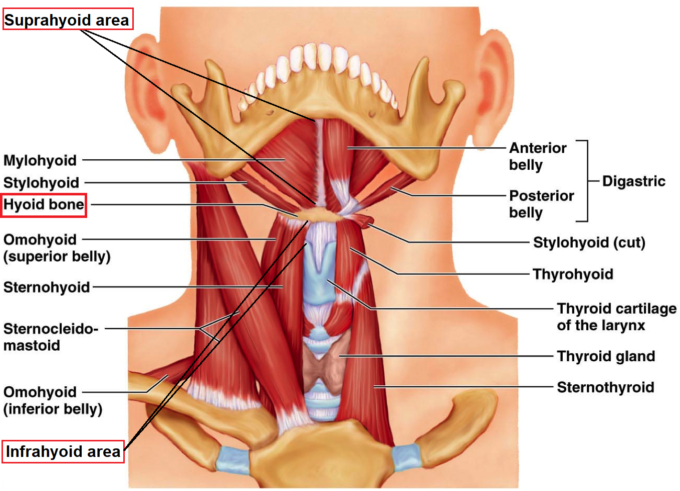
Areas of interest emphasized with red boxes
Results of evaluation
- It took several seconds for the patient to start to swallow. He couldn’t do it immediately on command.
- The suprahyoid muscles were very sensitive during palpation. Discomfort increased significantly if even mild pressure was applied to the suprahyoid muscles while the patient swallowed.
- While gently holding the hyoid bone by both ends using the tips of my index finger and thumb, I asked the patient to swallow. As I mentioned above, it took him time to initiate swallowing, but additionally, it was obvious that his hyoid bone exhibited a very small vertical shift while he swallowed.
There weren’t any other pathological changes in his anterior neck. Previously, we had successfully treated several cases of dysphagia in our clinic. One of them we already described in our ‘News From the Clinic’ section of JMS:
MEDICAL MASSAGE vs. YEARS OF SUFFERING AFTER THYROID CANCER SURGERY
However, all those patients had dysphagia due to an identifiable cause: tension, the anterior scalene muscle, neck surgery, etc. This was the first patient in whom dysphagia had developed by itself, without any somatic or neurological initial trigger. Despite that, there was a very good chance that we could help him again, and we scheduled an appointment for the next day.
The video below illustrates the swallowing recorded before the first session. Please notice how long it takes for the patient to initiate the act of swallowing. Also, pay attention to the complete imbalance in the contraction of the suprahyoid muscles while he tries to swallow. His motor cortex spent the time he used to prepare for swallowing trying to restore some coordination in the suprahyoid muscles’ contractions.
TREATMENT
We used only local therapy for approximately 30 minutes while the patient relaxed his lower jaw:
- Bi-manual effleurage along the drainage from the lower edge of the lower jaw to both supraclavicular fossae.
- Pinching, kneading and lateral stretching of the suprahyoid muscles
- Effleurage
- Bi-manual circular friction using the fingertips of the 2nd-3rd fingers from the midline of the suprahyoid area to the posterior angles of the mandible
- Effleurage
- Local bi-manual stretch of the suprahyoid muscles in the anterior-posterior direction
- Effleurage
- Gentle circular frictions using the fingertips of the index fingers in the infrahyoid space located below the hyoid bone and above the thyroid cartilage
- Effleurage
- Five lateral displacements of the entire throat (larynx, trachea and esophagus) to the right and then to the left, using gentle pressure applied to the sides of the throat during the patient’s exhalations with the flatly placed thumb and index finger
- Application of pressure (within comfort) with the flatly placed 2nd-3rd fingers of both hands positioned across the suprahyoid area while asking the patient to swallow repeatedly.
- While my index finger and thumb gently controlled both ends of the hyoid bone, I asked the patient to swallow and carefully resisted the hyoid bone’s upward shift during each swallow.
- Effleurage
Here is a video recorded after the second session. Notice that the patient was able to swallow more quickly. Readers may also notice smoother contractions of the suprahyoid area muscles. The area now normally ‘bulges’ forward compared to the first video, and this indicates increased flexibility of the suprahyoid muscles.
Unfortunately, it was impossible to illustrate in video format the difference in the vertical shift of the hyoid bone during swallowing before and after the treatment. However, the palpation after the first session indicated a significant increase in the mobility of the hyoid bone during each swallow. It took us three sessions of Medical Massage therapy to completely restore swallowing and eliminate dysphagia.
LESSONS
- Emotional stress may act as the initial trigger of dysphagia. Usually, it fades away by itself if stress conditions normalize. In the case of our patient, the initial stress triggered dysphagia, but the resulting imbalance in the action of the suprahyoid and infrahyoid muscles stayed and got progressively worse.
- The act of swallowing is a very complex event which requires perfect coordination between several key players. Even mild discoordination will compromise swallowing.
- His age and the absence of positive dynamics in his dysphagia, which the patient noticed, were a real concern, since its further progress might greatly affect the quality of his life.
- There are very limited treatment options doctors may offer to these patients, and unfortunately, manual restoration of the soft tissue balance using Medical Massage is not in the therapy arsenal used by American physicians.
Category: Blog
Tags: JMS 2019 Issue #1
