
Recently, I had the opportunity to witness firsthand the shortcomings of allopathic medicine in the rehabilitation of a patient with Post-Concussion Syndrome (PCS) and the high clinical effectiveness of Medical Massage therapy. I am forever grateful for the guidance provided by the Science of Massage Institute. It is great when a reliable clinical source is always available when a therapist encounters a new pathology he or she is not fully familiar with.
In issues #2 and #3 of JMS, 2016, I read an excellent article by Boris Prilutsky, MA, LMT on the pathophysiology of PCS and Medical Massage Therapy for the patients who suffer from it. Here are links to the original publication ‘Management Of Post-Concussion Symptoms And Post-Traumatic Encephalopathy With Medical Massage’:
On November 12th, 2019, I encountered my first patient with severe PCS and immediately re-read Prilutsky’s article, which gave me enough clinical guidance to start working on this patient.
MEDICAL MASSAGE vs. COMPLICATED CASE OF POST-CONCUSSION SYNDROME
A 28 y/o male presented to my office for a New Patient Examination/Clinical Interview seeking relief from symptoms related to multiple injuries sustained as a result of a motor vehicle accident (see images below) 3 weeks prior.
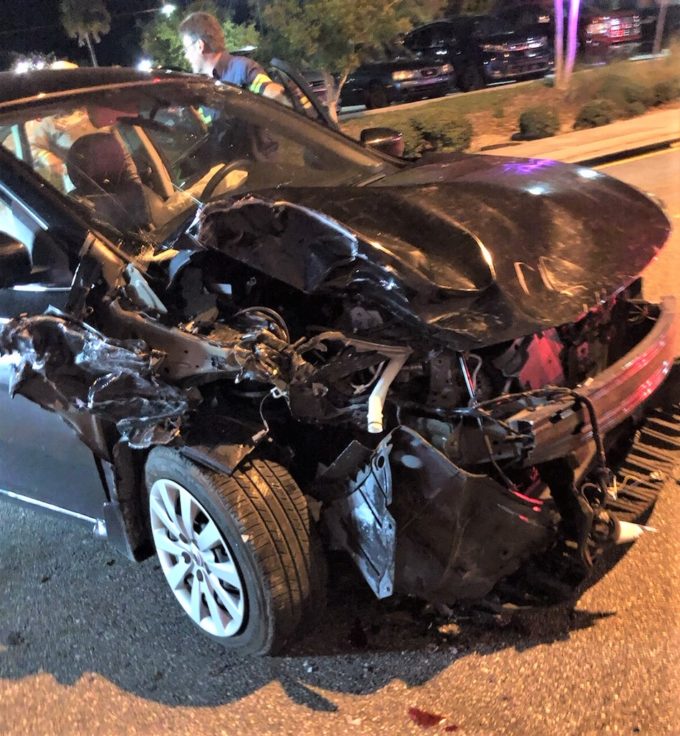
Immediately after the accident, he was seen in the ER and evaluated by the on-call MD, and a series of CT scans was performed. The diagnosis given was a Mild Concussion, with associated sprain/strain of the spinal musculature. He was prescribed Naproxen, advised to follow up with his primary care doctor and released.
Upon evaluation in our clinic, the patient was leaning severely to the left and was complaining about severe spasm and pain in the left lower back. Upon standing up, he was antalgic and unable to ambulate without assistance from his girlfriend; he suffered from staccato speech, and his eyes frequently closed and rolled back. To the average person, the patient might have looked as though he was under the strong influence of drugs and/or alcohol.
Due to the severity of the patient’s symptoms and prior to any care rendered, the Rivermead PCS Questionnaire was conducted and filled out by the patient’s girlfriend. The RPQ is used to determine the presence and severity of somatic, cognitive, and emotional symptoms of PCS after traumatic brain injury. This form can be easily found and downloaded from Google.
The patient was mentally unable to complete the questionnaire himself, so his girlfriend had to complete it for him. Upon completion of the form, his girlfriend said that the patient had been unusually verbally and physically aggressive since the accident. She made the comment:
“This is NOT my boyfriend – he never acts like this and I am very concerned”
The patient presented with the same clinical symptoms that B. Prilutsky mentioned in his article, and I was 100% certain that the patient was suffering from the set of combined psychosomatic abnormalities that had developed as a result of a concussion and that he was at that point in the Hypermetabolic Stage of Post-Concussion Syndrome.
I followed the steps from Part II of B. Prilutsky’s article, performed the entire PCS protocol and scheduled the patient for the PCS protocol daily for the next 5 days.
For the first 3 days, the patient was showing some progress. To fine-tune our therapy, I reached out to Dr. Ross Turchaninov and consulted him for advice. He suggested that the patient needed to be taking a prescription-strength water pill (diuretic) to reduce the immediate symptoms associated with the increase in intracranial pressure. The combination of an initial intake of diuretics with continuous application of the PCS protocol would speed up his recovery.
I immediately advised the patient to return to the ER or to a Walk-In clinic and to request a water pill prescription. The patient chose to go to a Walk-In clinic, where he was evaluated and denied diuretics! Frustrated and angry, the patient’s girlfriend promptly drove 3 hours roundtrip to fill a diuretic prescription she had.
On the 4th day, I witnessed a dramatic change. As I greeted the patient, he was standing upright without assistance, smiling and speaking clearly, with his eyes focused, and apologizing that he did not remember anything. While MM for PCS was continuously performed, the speed of the patient’s recovery was amazing.
At the next appointment, the Rivermead PCS Questionnaire was again given to the patient and this time he was able to complete the questionnaire on his own. The comparative results of the questionnaire were staggering. It was recommended that another series of 3 back-to-back MM treatments be scheduled.
On the 8th visit, I was able to further evaluate the secondary pathologies in the soft tissues that had developed as a result of the initial trauma. Examination revealed the presence of CTZs at the 1st and 2nd levels in the lower back and Reflex Zones in the Left Quadratus Lumborum Muscle.
As of this writing, MM for PCS continues every other day, and we are now alternating it with MM protocols to address post-traumatic changes in his lumbar area.
This case is an excellent example of how Medical Massage, when performed correctly and on time, can literally change patients’ lives!
LESSONS
- Head and neck trauma, besides causing various somatic pains and dysfunctions, may trigger personality changes, and the therapist must be patient and ready to deal with the sometimes nasty behavior exhibited by the patient.
- In complex clinical cases, the therapist’s ability to identify the treatment priorities is the key to final success. Notice that the patient came to the office with the main complaint of severe pain and dysfunction in the lower back, but Dr. Cullers noticed and correctly identified that, although lower back pain and dysfunction were indeed present, the treatment priority was PCS.
- Each therapist must be open-minded enough to use whatever is available to help the patient as much and as soon as possible. Don’t get stuck with only what you were trained in and currently use. Establish co-referral relations with other medical professionals and therapists. The decisive help to patients with a complex clinical picture comes from a comprehensive approach to their therapy, in which abnormalities are attacked from different directions at the same time. There is always room for adding medications, acupuncture, strengthening exercises, etc., if needed. In this particular case, the initial usage of diuretics additionally sped up the patient’s recovery.
- Please use the search window on our main educational website, Medical Massage Courses & Certification, if you encounter a complex clinical case and don’t know how to proceed. The solution may already be there, since it may have been shared earlier by a colleague and published in the JMS.
Category: Blog
Tags: JMS 2020 Issue #1
