
In the July-August, September-October, and November-December 2010 issues of JMS, we published a three-part article on TMJ dysfunction, and in Issue #1 of 2011, we published a follow-up on the same subject. We tried to present to readers as much comprehensive information as possible on the subject of TMJ pathology, as well as on available massage and manual therapy treatment options.
We did not discuss the critically important issue of intra-oral treatment of TMJ dysfunction in either article. Unfortunately, from a legal point of view, manual treatment in body cavities is outside the scope of the massage profession, even if the practitioners have proper training. In some states, chiropractors and physical therapists are even prohibited from performing it. This was the reason we didn’t include the protocol of intra-oral treatment for TMJ dysfunction.
Mrs. Gail Falzon, RN, noticed the absence of this important information and contacted us, offering an excellent answer to this problem. The MyoFree® Self-Massage Tool, which she developed, allows the patient to conduct self-treatment, either learning on their own or under the practitioner’s guidance and supervision. In such cases, the practitioner works on the outside, addressing the externally located masticatory and cervical muscles, while the patient at home is able to address the inner masticatory muscles, thus supporting the work of the practitioner on the external ones.
We are sure that her elegant solution is a very important tool for everyone who works on patients with TMJ dysfunction, headaches and atypical face pain. First of all, it allows those involved to avoid legal controversy. Secondly, it involves the patient in the treatment process, which is a great psychological tool. Thirdly, it allows individuals to avoid technical difficulties that practitioners frequently face when they use intra-oral treatment. These difficulties arise when the patient is unable to open their mouth wide enough for the practitioner to conduct effective therapy or when the practitioner has large hands and fingers while the patient’s mouth is anatomically smaller.
Thus, we see the MyoFree® Self-Massage Tool and instructional video as a very important treatment system. This is why we would like our readers to consider the article below as an important professional piece rather than typical advertising.
Sincerely,
Dr. Ross Turchaninov
Dr. Ali A. Bipar
CRANIOFACIAL PAIN SYNDROMES AND INTRA-ORAL TRIGGER POINTS
According to medical statistics, muscle dysfunction accounts for 85% of all pain syndromes. This is especially true for those suffering from craniofacial pain, including TMJD, headaches, atypical face pain (sometimes diagnosed as neuralgias) and cervical pain. Patients presenting with head, neck and jaw pain are sometimes challenging, as there can be multiple components to assess and treat.
According to the National Institute of Dental and Craniofacial Research, the most common form of TMJD is myofascial pain, yet it is not taught in dental schools. In addition to bite splints, dental professionals use modalities such as biofeedback, external TENS and medications to relax the muscles.
Attempts to relax the muscle simply cause an active trigger point (TP) to become latent, leaving the impression that all is well. It has been an enormous challenge to educate the dental community on the difference between “relaxing” muscle and “releasing” muscle dysfunction.
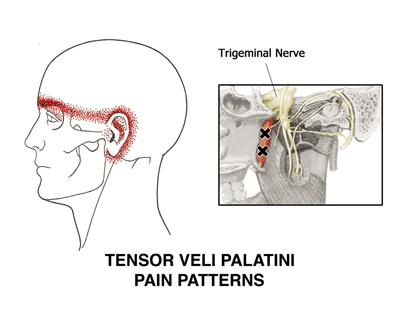
Because latent TPs (not causing an active pain complaint) can still decrease the range of motion, weaken the muscle and pull on bony attachments, it is important that we, as clinicians, not only correct the myofascial component but also teach the patient how to self-treat when TPs become active again, causing a myriad of painful symptoms and referred pain (see Fig. 1).
There have been many scientific and clinical publications pointing to TP infestation as either the central cause of or a significant contributor to painful syndromes and myofascial disorders, such as those seen in TMJD and other craniofacial pain (Simons et al., 1999; Fricton et al., 1985; Fricton, 1999; Mackley, 1990; Alvarez and Rockwell, 2002).
In a study involving 300 patients who had all been involved in a motor vehicle accident, the most common clinical findings identified on medical evaluation were the following: jaw pain, neck pain, post-traumatic headache, jaw fatigue, and severe TMJ crepitus or clicking. The most common diagnoses, in order, were masseter muscle trigger points, closing jaw muscle hyperactivity, and advanced disc derangement (Friedman and Weisberg, 2000).
Intra-oral TPs are often the underlying cause of headache and face pain, but our society is more versed in prescribing medications that cover up the actual “source” of pain. Nothing is quite as gratifying as watching a patient diagnosed with Trigeminal Nerve Neuralgia discover that his or her pain is actually from a TP rather than true nerve damage. I’ve witnessed several patients get off multiple anti-seizure medications prescribed for nerve pain they didn’t require in the first place. It is my personal goal that intra-oral trigger points be ruled out before a patient is given a hopeless diagnosis of trigeminal neuralgia or tic douloureux.
INTRA-ORAL TRIGGER POINT RELEASE
Intra-oral TP work is slowly becoming more common in therapy practice but is not the norm in the therapy curricula of our massage and PT schools. There are five major muscle groups found inside the mouth, which also include other surrounding muscles. For example, the tensor veli palatini and internal pterygoids, located in the roof of the mouth, can be the cause of tension-type headache, pain behind the eyes and sinus pressure. Dr. David G. Simons, MD, agreed with the referred pain pattern shown in Fig. 1, although this particular one is not found in the current TPM.
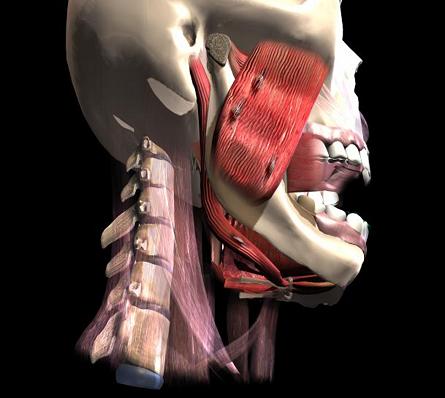
TPs are palpable contraction knots (see Fig. 2) or taut bands within the muscle/fascia that will ultimately change or alter muscle tension, which can lead to secondary problems of internal derangement, arthritis, and/or faulty joint mechanics leading to ultimate joint erosion and breakdown (Peroz and Tai, 2002). Whether primary or secondary, the presence of TPs can perpetuate disability and worsen the prognosis if they are not considered and treated. An intricate pathway of nerves and blood vessels runs through the muscles of mastication. Any disruption of normal function can lead to severe pain.
Personally, the whiplash and closed head injury I suffered in an MVA not only exacerbated a pre-existing TMJ disorder but also caused me to have headaches around the clock. There seemed to be no medication or solution to help ease the pain, and I was convinced by an oral surgeon that I needed complete reconstructive jaw surgery. Not only did the surgery not work, but it also made the pain worse as I endured yet another two years of braces to correct the bite.
Desperate for help, I asked for a physical therapy referral and was incredibly fortunate to find a PT well versed in treating TMJD and headaches. She taught me how to self-treat using intra-oral TP release techniques, and for the first time, I experienced true pain relief that surprisingly was almost immediate. Because the treatment was so profound, I began teaching and treating others while continuing research efforts. It soon became evident that both reaching these muscle groups and following the release response all the way through were nearly impossible with the fingers and thumbs alone.
The MyoFree® SOLUTION
Based on years of research and product development, the patented MyoFree® Solution was born. The self-help “kit” consists of the easy-to-use MyoFree® Self-Massage Tool (see Fig. 3) and the easy-to-learn Inside-Outside™ technique. The instructional DVD uses 3D animation of the muscle groups to teach the location and treatment of intra-oral TPs using ischemic pressure. A full-color Quick Start Guide is also included, showing an open-mouth diagram and written instructions to complement the video. A carrying case is included for travel and safe storage. (Note* The MyoFree® Massage Tool is for Patient Use Only!)
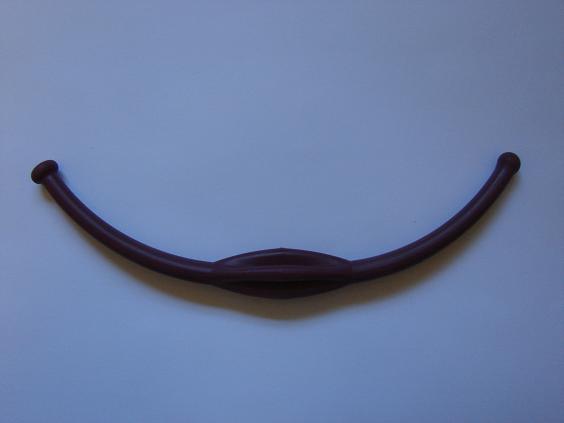
Inactivating the TPs from both sides, if possible, renders much more effective results. Also, a problem with most patients is the inability to treat the tensor veli palatini and internal pterygoids found in the roof of the mouth without eliciting a gag reflex. The MyoFree® massage tool (see Fig. 3) is small in diameter, which allows even those with severe hypomobility of the TMJ to self-treat. One end of the device is shaped like a golf tee and mimics the thumb. The other end is a very small ball and was designed to treat the attachment area of the lateral pterygoid, which is located in a very small anatomical notch. Practitioners often complain that they can’t even reach this area with their pinky finger, as it is so small and hard to reach.
There are two videos I would like to share with readers as examples of the clinical application of the MyoFree® Self-Massage Tool. The first video presents the intra-oral treatment of tension and active trigger points developed in the medial pterygoid muscle. As readers know, this muscle is accessible to direct therapy only through an intra-oral approach. The MyoFree® Self-Massage Tool eliminates the necessity of intra-oral treatment conducted by the practitioner to achieve stable clinical results, while involving the patient in the treatment process.
The MyoFree® Self-Massage Tool has another important benefit: its regular application by the patient between treatment sessions, when the practitioner concentrates on the external treatment and realignment of the TMJ, is very effective.
The second video demonstrates self-application of the MyoFree® Self-Massage Tool on the masseter muscle, which is usually targeted by practitioners during external therapy. The MyoFree® Self-Massage Tool allows the patient to work on the masseter muscle combining external and intra-oral approaches at the same time.
An important advantage of the MyoFree® Self-Massage Tool is its future reapplication by the client to maintain pain- and tension-free TMJ/headache symptoms after the entire treatment course is over.
Most therapists consider Dr. David G. Simons, MD, to be the “father” of TP therapy, since he co-wrote the Trigger Point Manual with Dr. Janet Travell. After watching the DVD and using the MyoFree® massage tool on himself, Dr. Simons wrote a two-page testimonial to the dental profession on the importance of intra-oral TP release and why the MyoFree® device is so effective. His testimonial and other resource materials can be found at TMJ Tools – The Pressure Positive Co.
SUMMARY
Anyone who has suffered a head injury or whiplash, or who has TMJD and/or headaches, should be made aware of these self-help techniques as part of a comprehensive approach to rehabilitation. We, as therapists, pride ourselves on comprehensive home programs and providing knowledge that empowers a patient to become involved in their own wellness. TPs can be primary or secondary, but either way, their presence can perpetuate disability, worsen the prognosis and interfere with primary interventions if not considered and treated. Left untreated, TMJD can become progressively worse and cause permanent damage within the tissues.
Trigger points have a sensory component but can also manifest as tension-altering entities that, over time, can lead to uneven bite mechanics and restricted mouth opening (Dijkstra et al., 1999). Research shows that TPs are a common component of diagnoses related to the head, neck and jaw. Intra-oral TP release not only has a huge impact on the muscles of the face and jaw but also has a remarkable cervical component. Any therapy that can eradicate or control TPs should eventually become a standard part of the total treatment intervention for these difficult-to-treat conditions.
The MyoFree® Solution is a lifelong, self-help, pain-relief system that teaches a patient how to self-manage their muscle pain symptoms for the rest of their life! The real beauty of the system is that anyone can easily learn the techniques. If you would like to learn these techniques, you will add a new important modality to your current practice and help desperate patients.
OTHER IMPORTANT FACTORS TO CONSIDER
There is never a single modality of treatment for these complicated diagnoses, but because intra-oral trigger point release is such a critical part of the pain puzzle, pairing it with existing treatments renders far more beneficial results. Also important, of course, are teaching stretching and strengthening exercises and evaluating posture from the feet up, body mechanics, pelvic tilt and other perpetuating factors that can lead to the formation of TPs. Chemical imbalances and nutritional factors (Ferritin, Vitamin B1, Vitamin B6, Vitamin B12, Vitamin D, Serum Folate, Calcium, TSH, and serum magnesium and potassium) should also be considered in the overall evaluation of muscle pain and dysfunction.
The MyoFree® Solution is available at The Pressure Positive Company Backnobber Self Care Massage Tool and retails for $59.00. Wholesale and health professional inquiries are welcome. 800-603-5107.
REFERENCES
- Alvarez DJ, Rockwell PG. Trigger points: diagnosis and management. Am Fam Physician. 2002;65(4):653-660.
- Dijkstra PU, Hof AL, Stegenga B, de Bont LGM. Influence of mandibular length on mouth opening. J Oral Rehabil. 1999;26(2):117-122. doi:10.1046/j.1365-2842.1999.00358.x
- Fricton JR. Masticatory myofascial pain: an explanatory model integrating clinical, epidemiological and basic science research. Bull Group Int Rech Sci Stomatol Odontol. 1999;41(1):14-25.
- Fricton JR, Kroening R, Haley D, Siegert R. Myofascial pain syndrome of the head and neck: a review of clinical characteristics of 164 patients. Oral Surg Oral Med Oral Pathol. 1985;60(6):615-623. doi:10.1016/0030-4220(85)90364-0
- Friedman MH, Weisberg J. The craniocervical connection: a retrospective analysis of 300 whiplash patients with cervical and temporomandibular disorders. Cranio. 2000;18(3):163-167. doi:10.1080/08869634.2000.11746128
- Mackley RJ. Role of trigger points in the management of head, neck and face pain. Funct Orthod. 1990;7(5):4-14.
- Peroz I, Tai S. Masticatory performance in patients with anterior disc displacement without reduction in comparison with symptom-free volunteers. Eur J Oral Sci. 2002;110(5):341-344. doi:10.1034/j.1600-0722.2002.21284.x
- Simons DG, Travell JG, Simons LS. Myofascial Pain and Dysfunction: The Trigger Point Manual. Vol 1. 2nd ed. Lippincott Williams & Wilkins; 1999.
ABOUT THE AUTHOR
Gail Falzon, RN
Gail Falzon, RN, is a myofascial practitioner who specializes in craniofacial pain disorders. She treats patients in southeast Michigan, teaches other professionals and speaks at national conferences for therapists and other medical/dental clinicians who work with TMJD, headaches and atypical face pain. She is the founder of TMJ Pain Solutions and the inventor of the MyoFree® Solution. More information can be found at TMJ Tools – The Pressure Positive Co and Facebook.
Her contact information:
TMJ Pain Solutions
7446 Lochmoor Dr.
Ypsilanti, MI 48197
734-277-5711
gail@tmjpainsolutions.com
Category: Medical Massage
Tags: JMS 2011 Issue #3
