
From the Author
The Editor-in-Chief of the Journal of Massage Science, Dr. Ross Turchaninov, recently invited me to write an educational article on a topic of my choice. As he stated, “Our readers should be able to learn from your article.” This request was both a great honor and a meaningful professional recognition.
Dr. Turchaninov—an MD, PhD, and medical massage practitioner—possesses unique expertise in biomedical science and the science of medical massage. His invitation motivated me to present Medical Massage from a distinctive and clinically grounded perspective. I sincerely hope I have succeeded.
MEDICAL MASSAGE: SIMPLIFYING A COMPLEX MATTER
From Academic Training to Clinical Reality
Like many of my colleagues, I was trained within the traditional academic model: memorizing anatomy, studying physiology and pathophysiology, and preparing for examinations. Fortunately, alongside this theoretical education, we were also trained in a variety of hands-on techniques and massage protocols designed to address different somatic and chronic visceral disorders.
I say “fortunately” because massage education is often dominated by theoretical instruction, while remaining only partly connected to clinical reality. Hands-on training and practical application are frequently limited and overly basic.
After I graduated, my mentors played a crucial role in shaping my clinical thinking. Like many practitioners, I navigated the difficult path between academic standards and real-world clinical outcomes. Today, my own clinical experience allows me to continue carrying the torch of my teachers and share the science of Medical Massage with other therapists. The goal of this article is to simplify a complex subject: Medical Massage.
FIVE “MIRACLES” OF MEDICAL MASSAGE
I summarize the clinical power of massage science as the Five Miracles of Medical Massage.
- The First Miracle — Restoration of the Bioelectrical Properties of Soft Tissues
The human body is a bioelectrical machine. Everything—from our thoughts to muscle contractions and organ functions—is governed by bioelectrical events. Healthy tissues and organs possess a slightly negative electrical charge. As a result of trauma, poor ergonomics, or the formation of reflex zones caused by altered innervation, this normal negative charge shifts toward a positive state. This change is among the earliest and most fundamental pathological events in affected soft tissues.
Let me be completely frank with the readers: only the correct use of therapists’ hands, with properly applied Medical Massage (MM) techniques, allows us to change this pathological pattern in soft-tissue bioelectricity and to initiate the first critical step in local rehabilitation.
We restore normal bioelectrical activity in affected tissues by:
- Mechanically compressing soft tissues and generating piezoelectrical potentials
- Using proper drainage techniques to restore normal streaming potentials and prevent local edema
These two powerful clinical tools help restore the healthy negative charge within affected tissues. At the same time, the newly generated bioelectricity resets the patient’s central nervous system and initiates systemic physiological responses.
No other branch of medicine is capable of addressing soft tissue dysfunctions through such a variety of hands-on techniques that directly influence these intimate bioelectrical recovery processes.
- The Second Miracle — The Power of Technique
The correct application of MM techniques determines the clinical outcome. From therapist to therapist, I continue to observe how limited and restricted hands-on education remains in the majority of massage schools. As a result, clinical effectiveness is greatly reduced and therapeutic outcomes become inconsistent.
By applying different MM techniques during treatment, therapists activate various families of peripheral receptors within the affected tissues. These receptors generate bioelectrical activity in the form of action potentials (sensory inflow) that travel to the patient’s brain, forcing the CNS to reset its function and establish a healthier motor outflow back to the soft tissues.
Thus, through properly trained hands, therapists reshape and reset the patient’s central nervous system, initiating healing processes.
Here are several important examples:
- The inhibitory regime of Medical Massage techniques helps eliminate the hyperirritability of nociceptors (a.k.a. pain receptors) by resetting the gate-control mechanism located within each spinal segment. By “closing” sensory gates in the posterior horns of the spinal cord, we reduce pathological ascending sensory inflow to the thalamus and cortex, preventing their overstimulation.
- Targeted stimulation of soft tissues through properly selected MM techniques intensifies acetylcholine release. This becomes a critical factor in suppressing excessive sympathetic tone and restoring balance within the autonomic nervous system, which regulates all body functions.
- While MM techniques mechanically stimulate soft tissues, newly released acetylcholine also supports mitochondrial biogenesis—the formation of new mitochondria from existing ones—thereby increasing ATP production. If bioelectricity represents the command system of the body, ATP serves as the fuel that powers its functions.
Thus, every massage technique developed through scientific and clinical research possesses its own specific goals, mechanisms of action, and therapeutic applications.
- The Third Miracle — Restoration of Autonomic Nervous System Balance
Perhaps the most profound effect of Medical Massage is its ability to regulate the autonomic nervous system (ANS), which is frequently disrupted by chronic somatic and visceral dysfunctions.
In a healthy body, the interaction between the sympathetic (“fight or flight”) and parasympathetic (“rest and digest”) systems must be completely balanced. According to Professor Hans Selye, the father of Stress Theory, nearly every pathological condition starts with an imbalance within the ANS. Modern science increasingly recognizes this imbalance as one of the earliest stepping stones in the development of disease, aside from trauma, infections, or congenital abnormalities. Restoring balance between sympathetic and parasympathetic activity is essential for healing.
Once again, I firmly state that no medication, exercise, or adjustment is capable of restoring this balance as effectively as the therapist’s hands when properly applying MM techniques to individual families of peripheral receptors on a layer-by-layer basis.
This restoration occurs through a variety of mechanisms, including:
- Lymph Drainage Massage
- Friction techniques
- Lateral Shift techniques
- Percussion techniques engaging the H-reflex
- Acetylcholine release and receptor normalization
- The Fourth Miracle — Integration of Energy Work
Medical Massage should also incorporate elements of energy work. As mentioned earlier, the human body is a bioelectrical machine. However, bioelectricity is not merely an internal phenomenon. Modern science demonstrates that the body radiates bioelectrical energy, forming an electrical field around us. In cases of chronic somatic and visceral dysfunction, disturbances within the body’s internal bioelectricity also affect this external field, altering our normal bioelectrical interactions with the environment.
If therapists are properly trained and continuously develop their ability to generate and concentrate bioelectrical energy during treatment, this additional energy may assist in recovery. In such cases, the therapist’s own bioelectrical activity becomes another clinical tool.
Scientists are now gaining a better understanding of the role of energy work—not only in enhancing therapeutic outcomes but also in protecting practitioners’ health.
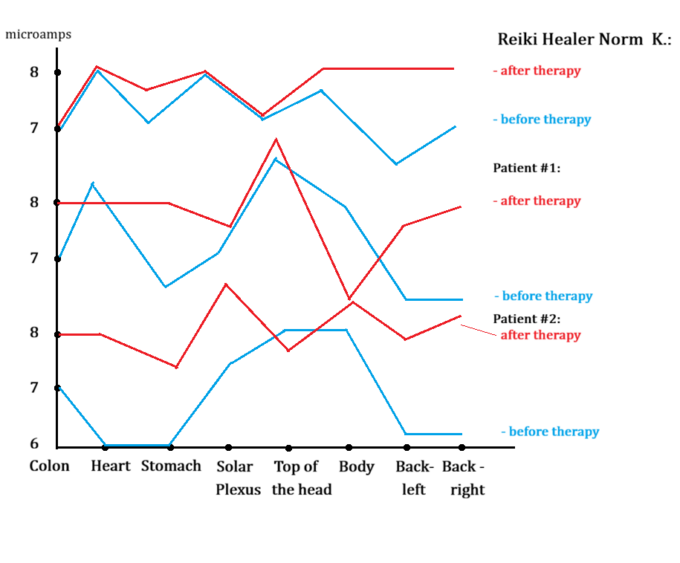
Here are the results of a fascinating study (Kuman, 2017). The scientist examined the personal electromagnetic field of Reiki healer Norman K. before and after therapy. Changes in the personal electromagnetic field were also measured in two different patients before and after a Reiki session.
Each measurement was performed using very sensitive equipment, with a reference electrode held in the measured individual’s left hand and a set of specially designed measuring electrodes placed at the key measurement points. The obtained data were processed using a system analyzer and a computer. Fig. 1 illustrates the results of the study. JMS modified the original diagram from the article using colors to better visualize the data.
Another interesting example is the application of true electrical vibration at 60 Hz. This vibration triggers uniform oscillation of atoms and molecules within soft tissues at a similar frequency. As a result, tissues generate new elementary particles known as phonons, creating a so-called “phonon wind.” This process may become another important factor in restoring normal bioelectricity, reducing local inflammation, and improving tissue function.
- The Fifth Miracle — The Power of Knowledge and Adaptation
Massage science relies on the cross-application of various techniques and modalities. The clinical solution does not lie in becoming confined to one or two treatment methods.
For example, no matter how effective Neuromuscular Therapy or Myofascial Release may be, each possesses its own specific clinical niche. The ultimate solution for complex cases lies in the therapist’s ability to creatively combine techniques and modalities based on a detailed evaluation of the patient’s soft tissues.
In this way, therapists create individualized treatment plans even for patients presenting with similar diagnoses.
Furthermore, every technique or modality presented to therapists should be independently examined, clinically tested, and supported by published scientific evidence.
To illustrate the importance of adaptation, let us consider Sports Massage. Pre-event Sports Massage increases blood flow velocity, stimulates mitochondrial activity, and enhances oxygen delivery to myofibrils, thereby helping athletes reach peak performance.
From a cross-application perspective in massage science, these same physiological principles can and should be incorporated into Medical Massage protocols for patients with somatic dysfunctions.
We must remain flexible in our clinical decisions—understanding what to use, what to avoid, and how to adapt treatment strategies to consistently achieve stable clinical outcomes.
In Part II of this article, we will discuss the clinical application of Medical Massage in the context of Long Post-COVID Syndrome and chronic stress-related disorders, which have become a major focus of my practice over the past five years.
REFERENCES
- Kuman M. Measuring Reiki healing—mystery, placebo, or real energy healing? J Altern Complement Integr Med. 2017;3:022. doi:10.24966/ACIM-7562/100022
ABOUT THE AUTHOR
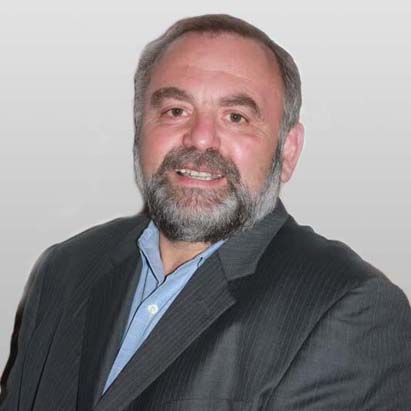
Boris Prilutsky, LMT, MA
Mr. B. Prilutsky has practiced and taught Medical and Sports Massage for more than 50 years. He has a master’s degree in physical education and rehabilitation from Ukraine.
Mr. Prilutsky has worked with athletes and world dignitaries throughout Europe, Israel, and the USA. He is the founder of the Institute of Professional Practical Therapy in Los Angeles, and to date, he has trained thousands of therapists worldwide. Boris Prilutsky has published extensively on various topics of physical medicine and rehabilitation.
Category: Medical Massage
Tags: JMS 2026 Issue #1
